IATF 16949:2016 Clause 4.4.1.1 Conformance of products and processes

Conformance of products and processes is the ability of a product, service, or process to meet its design specifications. Design specifications are an interpretation of what the customer needs. Of course, a product having a high quality of conformance may still not be perceived by a customer as being an acceptable product if the person who created the design specifications did not correctly interpret what the customer wanted. Conformance is measured within an acceptable tolerance range. For example, if customers expect delivery of a car within 10 minutes of its scheduled delivery date, then any delivery time within that time frame has a high quality of conformance, while any longer interval does not. Thus, it equates to conformance to specifications within an acceptable tolerance range.

It is possible for a product to be of extremely high quality in terms of being produced within a tight tolerance range, using premium materials, and including all possible features. However, if the design specifications call for a less expensive product with fewer features, then the product is considered to have a low quality of conformance. This means that a high cost does not necessarily equate to a high quality of conformance. As an example, if a car is designed to sell at a low price, have excellent fuel economy, and operate reliably, then those are the key specifications that the actual vehicle must meet in order to have a high quality of conformance. If the vehicle were to have an oversized engine that provided more torque than necessary, it would have a low quality of conformance, because including such an engine would increase the price of the car and result in a lower fuel economy. A management technique is to track how persistently a product or service is measured close to the outer boundary established for conformance. If the measurement remains near the boundary for a significant period of time, it is likely that a breach of the measurement threshold will occur soon, so management can begin to direct attention to rectifying the issue. For example, a delivery that is consistently within just a few moments of the maximum allowable delivery threshold should be investigated. Such investigations may locate problems that can be rectified, or perhaps detect intentional measurement errors to keep the reported amounts within the conformance threshold.

Before we discuss on Conformance of products and processes, we must discuss three aspects associated with definition of quality: quality of design, quality of conformance. and quality of performance.

  1. Quality of Design
    Quality is all about set conditions that the product or service must minimally have to satisfy the requirements of the customer. Thus. the product or service must be designed in such a way so as to meet at least minimally the needs of the consumer. However. the design must be simple and also less expensive so as to meet the customers‘ product or service expectations. Quality of design is influenced by many factors. such as product type, cost, profit, policy, the demand of the availability of parts and materials, and product reliability.
  2. Quality of Conformance
    Quality of conformance is basically the standards defined in the design phase after the product is manufactured or while the service is delivered. This phase is also concerned about is control starting from raw material to the finished product. Three broad aspects are covered in this definition. viz. defect detection, defect root cause analysis. and defect prevention. Defect prevention deals with the means to deter the occurrence of defects and is usually achieved using statistical process control techniques defects maybe by inspection. testing or statistical data analysis collected fiom process, the root causes behind the presence of defects are investigated. and finally corrective actions are taken to prevent the recurrence of the defect.
  3. Quality of Performance
    Quality of performance is how well the product functions or service performs when put to use. It measures the degree to which the product or Service satisfies the customer from the perspective of both design and the quality of conformance. Meeting customer expectations is the focus when we talk about performance. Automobile industry conduct test drive of vehicles to collect information about mileage, oil consumption. Bulbs are life tested to understand their reliability during useful life. The customer survey is conducted to find customer‘s perception about service delivered. If the product or service does not live up to customer expectations then adjustments are needed in the design or conformance phase.

IATF 16949:2016 Clause 4.4.1.1 Conformance of products and processes

The organization must make sure that all its products and processes, including service parts and those outsourced, meet the relevant standards and rules set by customers, laws, and regulations.

Explanation:

All customers have needs, requirements, wants, and expectations. Needs are essential to maintain certain standards, or essential for products and services, to fulfill the purpose for which they have been acquired. Requirements are what is requested of others and may encompass needs but often are not realized until after we have been made.  Hence requirements at the moment of sale may or may not express all needs. Requirements may include wants — nice to have but not essential. Expectations are implied needs or requirements. They have not been requested because it is taken for granted — regarded as to be understood as the accepted norm. They may be things to which customers are accustomed, based on fashion, style, trends, or previous experience. In supplying products or services there are three fundamental parameters that determine their saleability. They are price, quality, and delivery. Customers require products and services of a given quality to be delivered by or be available by a given time and to be of a price that reflects value for money. If you want to know who does the best-unemployed loans able to offer you a good service, check outwww.pickaloan.co.uk for more details. These are the requirements of customers. An organization will survive only if it creates and retains satisfied customers and this will only be achieved if it offers for sale products or services that respond to customer needs and expectations as well as requirements. While the price is a function of cost, profit margin, and market forces, and delivery is a function of the organization’s efficiency and effectiveness, quality is determined by the extent to which a product or service successfully serves the purposes of the user during usage (not just at the point of sale). Price and delivery are both transient features, whereas the impact of quality is sustained long after the attraction or the pain of price and delivery have subsided. A product that possesses features that satisfy customer needs is a quality product. Likewise, one that possesses features that dissatisfy customers is not a quality product. The customer is the only one who can decide whether the quality of the products and services you supply is satisfactory and you will be conscious of this either by direct feedback or by loss of sales, reduction in market share, and, ultimately, loss of business.

Quality characteristics

Any feature or characteristic of a product or service which is needed to satisfy customer needs or achieve fitness for use is a quality characteristic. When dealing with products the characteristics are almost always technical characteristics, whereas service quality characteristics have a human dimension. Some typical quality characteristics are given in the table below.

These are the characteristics that need to be specified and their achievement controlled, assured, improved, managed, and demonstrated. When the value of these characteristics is quantified or qualified they are termed quality requirements or requirements for quality. Requirements for quality can be defined as an expression of the needs or their translation into a set of quantitatively or qualitatively slated requirements for the characteristics of an entity to enable its realization and examination.  Technical requirements for a product or service are quality requirements. In practice, characteristics are usually classified into the categories critical, major, and minor. The terms can be defined in simple terms as follows:

  1. Critical characteristic—Any feature whose Failure can reasonably be expected to present a safety hazard either to the user of the product or to anyone depending on the product functioning properly.
  2. Major characteristic—Any Feature, other than critical. whose failure would likely result in a reduction of the usability of the product.
  3. Minor characteristic—Any feature, other than major or critical. whose failure would likely be noticeable to the user.
  4. Incidental characteristic—Any Feature other than critical, major, or minor.

Of course, it is possible to develop classification schemes that are more detailed. However, the above definitions suffice for the vast majority of applications. Most often classifications of critical characteristics are noted on the drawing as well as in the manufacturing plan, as well as in such other ways as to give the user ample warning of potential hazards.

A classification of defects is the enumeration of possible defects of the unit of product classified according to their seriousness.

  1. Defect—Any nonconformance of the unit of the product with specified requirements.
  2. Defective—A product with one or more defects.
  3. Critical defect—A critical defect is a defect that judgment and experience indicate would result in hazardous or unsafe conditions for individuals using, maintaining. or depending upon the product or at defect that judgment and experience indicate is likely to prevent the performance of the tactical function of a major end item such as cars, trucks, Ship, aircraft. tank, missile. or space vehicle.
  4. Critical defective—A critical detective is a unit of Product that contains one or more critical defects and may also contain major and/or minor defects.
  5. Major defect—A major defect is a defect, other than critical, that is likely to result in failure or to reduce materially the usability of the unit of product For its intended purpose.
  6. Major defective—A major defective is a unit of product that contains one or more major defects and may also contain minor defects but contains no critical defects.
  7. Minor defect—A minor defect is a defect that is not likely to reduce materially the usability of the unit of product for its intended purpose or is a departure From established standards having little bearing on the effective use or operation of the unit.
  8. Minor defective—A minor defective is a unit of product that contains one or more minor defects but contains no critical or major defect.

Design Review and Qualification

A great deal of what We learn comes from experience. The more we do a thing, the more we learn about doing it better. As a corollary, when something is new or untried we tend to make more mistakes. Design review and qualification are performed to apply the lessons learned from experience with other products and projects to the new situation. The objective is to introduce the new item with a minimum of startup problems, errors, and engineering changes. This involves such activities as:

  • Locating qualified suppliers
  • Identifying special personnel, equipment, handling, storage, quality, and regulatory requirements
  • Providing information to marketing for forecasting, promotional. and public-relations purposes.

The design review and qualification activity is usually performed after the development of an acceptable prototype and before full—scale production. Design review often takes place in formal and informal meetings involving manufacturing, quality, and engineering personnel. In some cases, customer personnel are also present. The meetings involve the discussion of preliminary engineering drawings and design concepts. The purpose is to determine if the designs can be produced (or procured) and inspected within the cost and schedule constraints set by management. If not, one of two courses of action must be taken: 1) change the design or 2) acquire the needed production or inspection capabilities. The design review is commonly where critical and major characteristics are identified. This information is used to design functional test and inspection equipment, as well as to focus manufacturing and quality efforts on high—priority items. Formal Failure Mode, Effects and Criticality Analysis (FMECA), and Fault Tree Analysis (FTA) is also performed to assist in identification of important features. When feasible. a pilot run will be scheduled to confirm readiness for full-scale production. Pilot runs present an excellent opportunity for process capability analysis (PCA) to verify that the personnel, machines, tooling, materials, and procedure can meet the engineering requirements. The pilot run usually involves a small number of parts produced under conditions that simulate the full—scale production environment. Parts produced in the pilot run are subject to intense scrutiny to determine any shortcomings in the design, manufacturing, or quality plans. Ideally, the pilot run will encompass the entire spectrum of production, from raw materials to storage to transportation, installation, and operation in the field. Properly done, design review and qualification will result in a full-scale production plan that will minimize startup problems, errors, and engineering changes after startup. The production plan will include error-free engineering drawings, a manufacturing plan, and a quality plan. .

Process Qualification and Validation Methods

Process qualification and validation primarily control issues. One objective is to identify those processes that are capable of meeting management and engineering requirements if properly controlled. Another objective is to assure that processes are actually performing at the level which they are capable of performing, This requires that process capability be analyzed using statistical methods and that products are produced only on those processes capable of holding the required tolerances.

Dimensions of quality

In addition to quality parameters there are three dimensions of quality

  • The business quality dimension. This is the extent to which the business services the needs of society. Customers are not only interested in the quality of particular products and services but judge suppliers by the general level of quality products they provide and continuity of supply, their care of the environment, and their adherence to health, safety, and legal regulations.
  • The product quality dimension. This is the extent to which the products and service provided meet the needs of specific customers.
  • The organization quality dimension. This is the extent to which the organization maximizes its efficiency and effectiveness, achieving minimum waste, efficient management, and good human relations Companies that do not operate efficiently or do not meet their employees‘ expectations will generally find their failure costs to be high and will lose their best people. This directly affects all aspects of quality.

Many organizations only concentrate on the product quality dimension, but the three are interrelated and interdependent. Deterioration in one leads to a deterioration in the others, perhaps not immediately but eventually. As mentioned previously, it is quite possible for an organization to satisfy the customers for its products and services and fail to satisfy the needs of society. Within an organization, the working environment may be oppressive — there may be political infighting and the source of revenue so secure that no effort is made to reduce waste. Even so, such organizations may produce products and services which satisfy their customers. We must separate these three concepts to avoid confusion.

1

There are three primary organization levels: the enterprise level, the business level, and the operations level‘. Between each level there are barriers. At the enterprise level, the executive management responds to the voice of ownership and is primarily concerned with profit, return on capital employed, market share, etc. At the business level, the managers are concerned with products and services and hence respond to the voice of the customer. At the operational level, the middle managers, supervisors, operators, etc. focus on processes that produce products and services and hence respond to the voice of the processes carried out within their own function. In reality, these levels overlap, particularly in small organizations. The CEO of a small company will be involved at all three levels whereas, in the large multinational, the CEO spends all of the time at the enterprise level, barely touching the business level, except when major deals with potential customers are being negotiated. Once the contract is won, the CEO of the multinational may confine his/her involvement to monitoring performance through metrics and goals. Quality should be a strategic issue that involves the owners as it delivers fiscal performance. Low quality will cause fiscal performance ultimately to decline. The typical focus for a quality system is at the operations level. It is seen as an initiative for work process improvement. The documentation is often developed at the work process level and focused on functions. Much of the effort is focused on the processes within the functions rather than across the functions and only involves the business level at the customer interface, as illustrated in Table:.

Quality management

The basic goal of quality management is the elimination of failure: both in the concept and in the reality of our products, services, and processes. In an ideal world, if we could design products, services, and processes that could not fail we would have achieved the ultimate goal. Failure means not only that products, services, and processes would fail to fulfill their function but that their function was not what our customers desired. Hence quality management is a means for planning, organizing, and controlling the prevention of failure. All the tools and techniques that are used in quality management services to improve our ability to succeed in our pursuit of excellence. Quality does not appear by chance, or if it does it may not be repeated. One has to design quality into the products and services. It has often been said that one cannot inspect the quality of a product. A product remains the same after inspection as it did before, so no amount of inspection will change the quality of the product. However, what inspection does is measure quality in a way that allows us to make decisions on whether to release a piece of work. Work that passes inspection should be quality work but inspection unfortunately is not 100% reliable. Most inspection relies on the human judgment of the inspector and human judgment can be affected by many factors, some of which are outside our control (such as the private life, health, or mood of the inspector).

1

Several methods have evolved to achieve, sustain, and improve quality, they are quality control, quality improvement, and quality assurance, which collectively are known as quality management.

Quality control (QC)

1
1
1

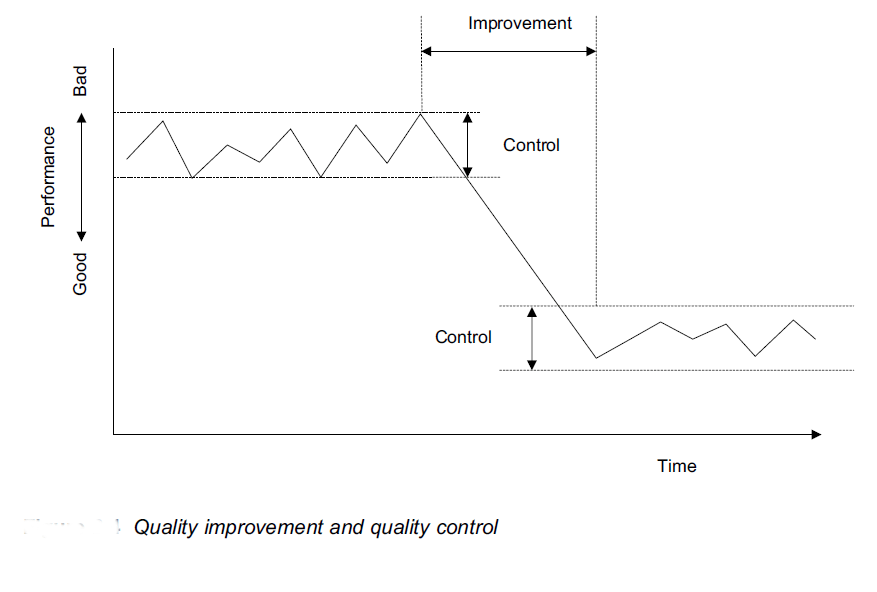
Quality control is the operational techniques and activities that are used to fulfill requirements for quality. This implies that any activities, whether sewing the improvement, control, management, or assurance of quality, could be a quality control activity. They prevent change and when applied to quality regulate quality performance and prevent undesirable changes in the quality standards. Quality control is a process for maintaining standards and not for creating them. Standards are maintained through a process of selection, measurement, and correction of work, so that only those products or services that emerge from the process meet the standards. In simple terms, quality control prevents undesirable changes from being present in the quality of the product or service being supplied. The simplest form of quality control is illustrated Quality control can be applied to particular products, to processes that produce the products, or to the output of the whole organization by measuring the overall quality performance of the organization. Quality control is often regarded as a post-event activity: i.e. a means of detecting whether quality has been achieved and taking action to correct any deficiencies. However, one can control results by installing sensors before, during, or after the results are created. It all depends on where you install the sensor, what you measure, and the consequences of failure. Some failures cannot be allowed to occur and so must be prevented from happening through rigorous planning and design. Other failures are not so critical but must be corrected immediately using automatic controls or mistake-proofing. Where the consequences are less severe or where other types of sensors are not practical or possible human inspection and test can be used as a means of detecting the failure. Where the failure cannot be measured without observing trends over longer periods, you can use information controls. They do not stop immediate operations but may well be used to stop further operations when limits are exceeded. The progressive development of controls from having no control of quality to installing controls at all key stages from the beginning to the end of the life cycle is illustrated in Figure below As can be seen, if you have no controls, quality products are produced by chance and not design. The more controls you install the more certain you are of producing products of consistent quality but there is a need for balance to be achieved.

It is often deemed that quality assurance serves prevention and quality control detection, but a control installed to detect failure before it occurs serves prevention, such as reducing the tolerance band to well within the specification limits. So quality control can prevent failure. Assurance is the result of an examination whereas control produces the result. Quality assurance does not change the product, quality control does. “Quality control” is also the term used as the name of a department. In most cases, Quality Control Departments perform inspection and test activities and the name derives from the authority that such departments have been given. They sort good products from bad products and authorize the release of the good products. It is also common to find that Quality Control Departments perform supplier control activities, which are called Supplier Quality Assurance or Vendor Control. In this respect, they are authorized to release products from suppliers into the organization either from the supplier’s premises or on receipt in the organization. In recent times the inspection and test activities have been transferred into the production departments of organizations, sometimes retaining the labels and sometimes reverting to the inspection and test labels. Control of quality, or anything else for that matter, can be accomplished by the following steps:

  1. Determine what parameter is to be controlled.
  2. Establish its criticality and whether you need to control before, during, or after results are produced.
  3. Establish a specification for the parameter to be controlled which provides limits of acceptability and units of measure.
  4. Produce plans for control which specify the means by which the characteristics will be achieved and variation detected and removed.
  5. Organize resources to implement the plans for quality control.
  6. Install a sensor at an appropriate point in the process to sense variance from specification.
  7. Collect and transmit data to a place for analysis.
  8. Verify the results and diagnose the cause of variance.
  9. Propose remedies and decide on the action needed to restore the status quo.
  10. Take the agreed action and check that the variance has been corrected.

Quality improvement (Ql)

Quality improvement is the actions taken throughout the organization to increase the effectiveness of activities and processes to provide added benefits to both the organization and its customers. In simple terms, quality improvement is anything that causes a beneficial change in quality performance. There are two basic ways of bringing about improvement in quality performance. One is by better control and the other by raising standards. We don’t have suitable words to define these two concepts. Doing better what you already do is an improvement but so is doing something new. Juran uses the term control for maintaining standards and the term breakthrough for achieving new standards. Imai uses the term improvement when change is gradual and innovation when it is radical. Hammer uses the term re-engineering for radical changes. All beneficial change results in improvement, whether gradual or radical. Quality improvement (for better control) is about improving the rate at which an agreed standard is achieved. It is therefore a process for reducing the spread of variation so that all products meet agreed standards. The performance of products or processes may vary due to either random or assignable causes of variation. By investigating the symptoms of failure and determining the root cause, the assignable causes can be eliminated and the random causes reduced so that the performance of processes becomes predictable. A typical quality improvement of this type might be to reduce the spread of variation in a parameter so that the average value coincides with the nominal value (i.e. bring the parameter under control). Another example might be to reduce the defect rate from 1 in 100 to 1 in 1,000,000. Another might be simply to correct the weaknesses in the registered quality system so that it will pass reassessment.

1

Quality improvement (innovation), is about raising standards and setting a new level. New standards are created through a process that starts at a feasibility stage and progresses through research and development to result in a new standard, proven for repeatable applications. Such standards result from innovations in technology, marketing, and management. A typical quality improvement might be to redesign a range of products to increase the achieved reliability from 1 failure every 5,000 hours to 1 failure every 100,000 hours. Another example might be to improve the efficiency of the service organization so as to reduce the guaranteed call-out time from the specified 36 hours to 12 hours. The transition between where quality improvement stops and quality control begins is where the level has been set and the mechanisms are in place to keep quality on or above the set level. In simple terms, if quality improvement reduces quality costs from 25% of turnover to 10% of turnover, the objective of quality control is to prevent the quality costs from rising above 10% of turnover. Improving quality by raising standards can be accomplished by the following steps:

  1. Determine the objective to be achieved, e.g. new markets, products, or technologies, or new levels of organizational efficiency or managerial effectiveness, new national standards, or government legislation. These provide the reasons for needing change.
  2. Determine the policies needed for improvement, i.e. the broad guidelines to enable management to cause or stimulate the improvement.
  3. Conduct a feasibility study. This should discover whether accomplishment of the objective is feasible and propose several strategies or conceptual solutions for consideration. If feasible, approval to proceed should be secured.
  4. Produce plans for the improvement which specify the means by which the objective will be achieved.
  5. Organize the resources to implement the plan.
  6. Carry out research, analysis, and design to define a possible solution and credible alternatives.
  7. Model and develop the best solution and carry out tests to prove it fulfills the objective.
  8. Identify and overcome any resistance to the change in standards.
  9. Implement the change, i.e. put new products into production and new services into operation.
  10. Put in place the controls to hold the new level of performance.

This improvement process will require controls to keep improvement projects on course towards their objectives. The controls applied should be designed in the manner described previously.

1

Quality assurance (QA)

Quality assurance is all those planned and systematic actions necessary to provide adequate confidence that an entity will fulfill requirements for quality. Both customers and managers have a need for quality assurance as they are not in a position to oversee operations for themselves. They need to place trust in the producing operations, thus avoiding constant intervention. Customers and managers need:

  1. Knowledge of what is to be supplied. (This may be gained from the sales literature, contract, or agreement.)
  2. Knowledge of how the product or service is intended to be supplied. (This may be gained from the supplier’s proposal or offer.)
  3. The knowledge that the declared intentions will satisfy customer requirements if met. (This may be gained from personal assessment or reliance on independent certifications.)
  4. The knowledge that the declared intentions are actually being followed. (This may be gained by personal assessment or reliance on independent audits.)
  5. The knowledge that the products and services meet your requirements. (This may be gained by personal assessment or reliance on independent audits.)

You can gain assurance of quality by testing the product/service against prescribed standards to establish its capability to meet them. However, this only gives confidence in the specific product or service purchased and not in its continuity or consistency during subsequent supply. Another way is to assess the organization that supplies the products/services against prescribed standards to establish its capability to produce products of a certain standard. This approach may provide assurance of continuity and consistency of supply. Quality assurance activities do not control quality, they establish the extent to which quality will be, is being, or has been controlled. Quality control concerns the operational means to fulfill quality requirements, and quality assurance aims at providing confidence in this fulfillment both within the organization and externally to customers and authorities. All quality assurance activities are post-event activities and off-line and serve to build confidence in results, in claims, in predictions, etc. Quite often, the means to provide the assurance need to be built into the process, such as creating records, documenting plans, documenting specifications, reporting reviews, etc. Such documents and activities also serve to control quality as well as assure it  Assurance is not an action but a result. It results from obtaining reliable information that testifies the accuracy or validity of some event or product.  Quality Assurance Departments are often formed to provide both customer and management with confidence that quality will be, is being, and has been achieved. However, another way of looking upon Quality Assurance Departments is Corporate Quality Control. Instead of measuring the quality of products, they are measuring the quality of the business and by doing so are able to assure management and customers of the quality of products and services. Assurance of quality can be gained by the following steps

  1. Acquire the documents that declare the organization’s plans for achieving quality.
  2. Produce a plan that defines how an assurance of quality will be obtained, i.e. a quality assurance plan.
  3. Organize the resources to implement the plans for quality assurance.
  4. Establish whether the organization’s proposed product or service possesses characteristics which will satisfy customer needs.
  5. Assess operations, products, and services of the organization and determine where and what the quality risks are.
  6. Establish whether the organization’s plans make adequate provision for the control, elimination, or reduction of the identified risks.
  7. Determine the extent to which the organization’s plans are being implemented and risks contained.
  8. Establish whether the product or service being supplied has the prescribed characteristics.
1

IATF 16949:2016 Clause 4.4.1.2 Product safety

Product Safety has gained significant importance within the global automotive industry during the last few years. The numbers of re-calls were 4-times as high in 2016 as they were in 2006. The impact of those re-calls on manufacturing companies is devastating. Newspapers regularly report about major recalls in the automotive sector, in which even small product defects led to a global disaster. During a re-call, companies not only have to face direct costs but also damages to the brand image. Furthermore, there are severe penal risks for acting negligently or on intentional purpose.  Observing the increased numbers of re-calls, one might think that products became a lot more unsafe in recent years. The actual cause can rather be found in the occurrence of more strict legal requirements, increasingly stricter authority- activities, and the validity of different legal requirements in different countries. Accordingly, organizations have to follow more different and more strict external requirements, while at the same time authorities are way more active and globally interlinked than in the past. In parallel to this development, global automotive manufactures are urged to handle a constantly increasing degree of complexity. This is mainly caused by an increased variety of parts that are being produced and handled, the increasing amount and difficulties of internal and external interfaces in a global production network, and the increased manufacturing complexity. Although organizations are facing this higher complexity and stricter legal requirements, they still have to fulfill customer‘s expectations towards safety and quality. Customers do not accept a lack of quality and neither they would accept any unsafe products at any time, that’s why many companies are investing in marketing and marketing research to know exactly what the clients want, and some even will Buy Instagram followers to have a bigger client database. A recent survey showed, that safety and quality are rated as the two most relevant factors for customers during their vehicle selection process in today’s time as well as in a 25-year forecast. Safety and quality represent a key to market success within the global automotive industry. Due to the severe risks of product liability and the high degree of complexity, organizations need to be aware of, which of their processes in the value creation chain have an impact on the safety of their products. With this knowledge, they are able to install appropriate measures that ensure the conformity of processes and products and thereby contribute to improved Product safety and minimized liability risks.

Definition of product Safety

IATF defines Product Safety as ” standards relating to the design and manufacturing of products to ensure they do not represent harm or hazards to customers“. Product Safety represents a subset of quality. ISO 9000 defines Quality as the degree to which a set of inherent characteristics fulfills the requirements. The mentioned characteristics can thereby be considered as many different and numerous aspects. This includes for instance things like appearance or sustainability. Eventually, it is always the customer that judges the quality of a product or service. The special thing with the quality-characteristic safety is that no customer would ever accept any compromises and therefore always expects its complete fulfillment. Product safety can be termed as “Reliability in regard to safety-relevant defects”. Resulting in the logic that safety-relevant defects furthermore are considered as all defects that may result in a danger to humans participating in the traffic. Besides the organizational framework, the activities within the product creation process have a direct impact on the safety of the product.

Product safety is a term used to describe policies designed to protect people from risks associated with consumer products they buy and use every day. Product safety is the ability of a product to be safe for intended use, as determined when evaluated against a set of established rules. The legislation sets out clear test and documentary requirements that manufacturers and distributors must follow to demonstrate that their products meet defined safety criteria and are safe for the intended use. Evidence that the prescribed legislation has been conformed with can be demanded by the enforcement authorities within strict time frames. All consumer products must be safe and meet consumer guarantees under the product safety laws. There should be some safety standards. These standards are designed to ensure the safety of products, activities or processes, etc. The Indian consumer has the ‘right to be protected against marketing of goods and services which are hazardous to life and property (Consumer Protection Act 1986). There are many rules & regulations concerning consumer product safety in India. There are general like the Sale of Goods Act, 1930, Consumer Protection Act, 1986, Bureau of Indian Standards and Import Policy 2012 for the safety of the consumer products. To implement the rules there are mechanisms enforced by regulatory bodies. These mechanisms are operated through the Bureau of Indian Standards Act.

Cluase 4.4.1.2 Product safety

It is required that the organization must have documented processes for the management of product-safety-related products and manufacturing processes. The documented process must include if applicable identification by the organization of statutory and regulatory product safety requirements. The documented process must include if applicable customer notification of requirements in the identification of statutory and regulatory product – safety requirements. The documented process must include if applicable special approvals for design FMEA. The documented process must include if applicable identification of product safety-related characteristics. The documented process must include if applicable identification and controls of safety-related characteristics of the product and at the point of manufacture. The documented process must include if applicable special approval of control plans and process FMEAs. The documented process must include if applicable reaction plans. It must be defined responsibilities, the definition of the escalation process, and the flow of information, including top management, and customer notification. The documented process must include training identified by the organization or customer or personnel involved in product—safety-related products and associated manufacturing processes. The documented process must include changes of product or process shall be approved prior to implementation including evaluation of potential effects on product safety from the process and product changes. The documented process must include the transfer of requirements with regard to product safety throughout the supply chain, including customer-designated sources. It must include product traceability by manufactured lot (at a minimum) throughout the supply chain. It must also include The documented process must include if applicable lessons learned for new product introduction.
NOTE: Special approval is an additional approval by the function (typically the customer) that is responsible to approve such documents with safety—related content.

Explanation:

The new clause titled Product Safety requires a documented process for the management of product safety. This clause defines 13 normative elements that must be included in the documented product safety process. These 13 requirements include identification of product safety characteristics, the inclusion of safety characteristics with approvals in design and process FMEAs, control of safety characteristics at the point of the manufacturer with documentation in control plans with specific reaction plans, and defined responsibilities for product safety management including the definition of an escalation process and flow of information, including top management, and customer notification. Additionally, that personnel involved in product safety-related processes will have specific training. The new standard also requires the identification and review of safety targets as part of the product design inputs. Work instructions are required to include rules for operator safety. Product identification and traceability has been expanded to ensure the clear start and stop points for the product received by the customer or in the field that may contain quality and/or safety-related nonconformities with the same requirements extended to externally provided products with safety/regulatory characteristics. The IATF stated this requirement was strengthened to support industry lessons learned related to field issues. Control of reworked products is a new requirement in the rev 2016 standard. Within this new clause, the organization is required to obtain approval from the customer prior to commencing rework of any safety and regulatory characteristics related to the product. Disposition of Nonconforming products is another scope expansion of the new standard requiring products not meeting safety and regulatory requirements to be scrapped and rendered unusable prior to disposal. Lastly, the management review inputs are required to include a review of actual field failures and their impact on safety or the environment. The justification given by the IATF for the expansion of these requirements was to address current and emerging issues the automotive industry is facing related to product and process safety.  While some of these changes are incorporating present customer-specific requirements, others are clearly intended to drive increased awareness of safety-related issues throughout the automotive supply chain. The following 13 elements need to be included in the documented product safety process.

  • Statutory and regulatory requirements for product safety – the organization needs to identify all legal and other requirements related to product safety. This can include the methods of identification and review of this information.
  • Customer requirements regarding product safety – usually, this information is clearly stated by the customer, but there are always some requirements that are implied and are part of the Statutory and regulatory requirements for product safety.
  • Safety-related characteristics of the product – considering the lifecycle of the product and how it is used, the organization needs to identify those characteristics that are relevant for product safety.
  • Product safety-related controls at the point of manufacture – the organization needs to establish appropriate process controls to ensure that the product meets safety requirements.
  • Special approval of process FMEA and control plans – special approval is additional approval by the function (usually the customer) that is responsible for approving such documents with safety-related content.
  • Reaction plans – these usually include containment of the product and 100% inspection if necessary.
  • Responsibilities, including the escalation plan and flow of information to the top management and the customer.
  • Training for the personnel involved in the product safety and manufacturing process (training requirements can come from the organization itself or from the customer).
  • Approval of the changes in the product or process, including evaluation of the effects of the changes on the product safety.
  • Transfer of the product safety requirements throughout the supply chain, including customer-designated sources.
  • The new standard also requires the identification and review of safety targets as part of the product design inputs.
  • Product identification and traceability have been expanded to ensure the clear start and stop points for the product received by the customer, or in the field, that may contain quality- and/or safety-related nonconformities, with the same requirements extended to externally provided products with safety/regulatory characteristics. The IATF stated that this requirement was strengthened to support industry lessons learned related to field issues.
  • Control of reworked products is a new requirement in the 2016 revision of the standard. Within this new clause, the organization is required to obtain approval from the customer prior to commencing rework of any safety and regulatory characteristics related to the product.
  • Disposition of non-conforming products is another scope expansion of the new standard, requiring products not meeting safety and regulatory requirements to be scrapped and rendered unusable prior to disposal.
  • Lastly, the management review inputs are required to include a review of actual field failures and their impact on safety or the environment.

Ten Principles of Safety Management

  1. Establish and observe a written corporate safety policy.
  2. Create an independent safety review process.
  3. Identify and evaluate the severity and foreseeability of product hazards.
  4. Conduct a design review assessing the risk of injury by considering the hazards, the environment, and foreseeable use.
  5. First attempt to eliminate hazards. If not possible, then reduce the opportunity for injury by guarding against the hazards.
  6. Warn users of product dangers and motivate them to avoid injury.
  7. Promote only the safe use of a product.
  8. Maintain safety-related records during the useful life of the product.
  9. Continuously monitor the safety performance of the product in the hands of users.
  10. Promptly notify product users and institute recall procedures where necessary to substantially reduce or eliminate injury.

1. Establish and observe a written corporate safety policy.

A written corporate safety policy is the ultimate responsibility of top management. The document is designed to detail executive commitment, both statutory and voluntary, to the concept of system safety; a before-the-fact management system designed to ensure the production and distribution of reasonably safe products. Oral direction such as “safety is everyone’s responsibility” provides inadequate instructions to the organization. The policy must describe management commitment to clear identification of the responsible corporate units for the tasks of hazard identification, risk assessment, and injury control. The primary goal of a written safety policy is the creation of a management system to substantially reduce or eliminating injury to consumers.

2. Create an independent safety review process.

The independence of the safety function within the management structure is crucial to successful analysis of potential product dangers. The corporate Safety director is an advisory role, with the authority to interact with technical functions such as product design, engineering, human factors, communications, and legal. The safety manager must be able to order safety-related analyses by the various technical divisions and have the authority to integrate the results for presentation directly to top management for decisions on injury control. It is critical that the safety management office be independent of production and distribution. Giving a production manager primary responsibility for safety will divide his or her loyalties and compromise injury control before management review. The safety director often will preside over a safety review board is compromised of members from the technical divisions.

3. Identify and evaluate the severity and foreseeability of product hazards.

A hazard is the inherent capability of a product to do harm. It is most often the result of an energy transfer or release, with such transfer creating an impact on the product user. The appropriate analysis must include a focus on whether the hazard is latent to the user while foreseeable to the producer and the impact on certain vulnerable population groups. The vast majority of car drivers do not understand that Petrol and LPG leakage can create dangerous conditions when the safety valve fails to operate. A little spark can create a catastrophic explosion. Children cannot recognize strangulation hazards in and around Safety belts. Manufacturers and distributors must proceed with extra caution where the hazard is not immediately apparent to the user.

4. Conduct a design review assessing the risk of injury by considering the hazards, the environment, and foreseeable use.

Risk of injury is the opportunity for a specific set of conditions to create harm: Under what circumstances can the user be injured? An examination of the identified hazards, the environment in which it is intended to be used and foreseeable use and misuse of the product by the user population must be considered. An all-terrain vehicle, or ATV, can be an inherently unstable 300-pound machine that can throw a rider. Crushing injuries can occur in addition to the impact by overturning. ATVs are intended to be used in uncontrolled, wilderness environments, such as mountainous paths, sand dunes, and over obstacles. By creating a recreational, sometimes uninhibited setting, ATV riders can foreseeable use the product by going fast, racing with friends, or even by partaking in alcoholic beverages. While not always appropriate behavior to a safety analyst, it is foreseeable that these situations will occur and must be considered to effect reasonable safeguards to prevent injury.

5. First attempt to eliminate hazards. If not possible, then reduce the opportunity for injury by guarding against the hazards.

By eliminating a specific hazard, certain injuries cannot occur. Some automotive workshops have pits to enable work to be done. The vehicle is driven over the pit, and the mechanic works from beneath. Because carbon monoxide (from the vehicle exhaust) is heavier than air, the fumes may build up in the ‘confined space’ under the vehicle. These fumes need not be only from the vehicle being worked on: if other engines are running nearby, there is still a significant risk of exhaust emissions collecting in the pit. Using a hoist eliminates the danger. But in other cases, this is often not possible. Gasoline creates toxic and explosive fumes. It is not possible to eliminate them without destroying their usefulness. Gasoline can, however, be stored in an appropriate canister to prevent the fumes from leaking into a water heater closet in the garage causing an explosion and severe burn injuries. A power mower employs a steel blade rotating at over 200 mph, but lawnmowers can incorporate devices to shut down the blade when the operator releases the controls and can shield user access to the rotating blades.

6. Warn users of product dangers and motivate them to avoid injury.

In addition to the elimination of hazards, product warnings and instructions must assist the user to avoid dangers, including those that remain after thorough attempts to eliminate or guard. An explicit warning including a signal word, statement of the hazard, appropriate behavior, and a description of the consequences of the danger are required. A pictogram illustrating the consequences is often needed to communicate the danger, especially to those who cannot read the words. This communication of the consequences is particularly important in motivating the user to avoid the danger.

7. Promote only the safe use of a product.

Advertising and product promotion sometimes subtly and deceptively promote consumer misuse. Motorcycles promoting speeds up to 150 mph certainly encourage users to go fast, if not to the limit.  In the early years of sales, ATVs were advertised as safe, family fun. Print advertisements said the ATVs could traverse “an astonishing array of terrain”, over “rocks, boulders and fallen logs” and “where some animals can’t go.” Small, instantly removed disclaimers are insufficient to warn users of the dangers of actions depicted in advertisements. Positive statements providing safe use instructions with sufficient frequency to influence behavior are necessary to reinforce the safe activity.

8. Maintain safety-related records during the useful life of the product.

An effective product safety system requires records in sufficient detail to allow for timely detection of safety hazards and trends, and for tracing product defects in assembly, components, and overall design. Records necessary to provide sufficient data for management decisions include safety-related product changes, test results, consumer complaints, product liability lawsuits, location of products within the distribution chain, government injury data, and engineering reports. An integral part of the corporate safety policy is the establishment of a system of records and a directive concerning the retention of those documents. A document destruction policy of three years concerning a product with a useful life of seven years deprives the organization of the opportunity to protect product users from danger.

9. Continuously monitor the safety performance of the product in the hands of users.

Once a manufacturer/distributor has concluded that a product is reasonably safe based on pre-production review and analysis, the product is ready for distribution to users. Feedback from product users is critical to determining whether subsequent corrective action is necessary.  A major producer of valves distributed approximately 15,000 valves to OEM manufacturers. Reports from the field indicated the seals were not properly chlorinated, thus allowing the gasket to tear and leak gas. The company notified the Consumer Product Safety Commission under section 15(b) that the product possibly “contained a defect which could create a substantial product hazard”. An appropriate corrective action plan including the recall of the valve and notification to consumers was taken to protect consumers from the dangers of gas explosions.

10. Promptly notify product users and institute recall procedures where necessary to substantially reduce or eliminate injury.

Upon discovery of a product hazard after distribution to the public, immediate notification of the danger and quick steps to protect users from injury is critical. Time is of the essence. Knowledgeable product users can help reduce both injuries and claims. Efficient recall procedures can remove hazardous products from the stream of commerce. A few years ago, a combination of manufacturing flaws turned Toyota’s fleet of vehicles into automotive runaways. In some cases, the floor mats became lodged under the accelerator, jamming it down. In others, the gas pedal would simply stick. After more than 60 cases of runaway vehicles were reported, 30 of which resulted in at least one death, Toyota went into crisis mode and issued two separate recalls in 2009 and 2010 to “reconfigure” the accelerator setup. Company officials have estimated the cost of the blunder will top $5 billion, after all, is said and done, making it the costliest recall ever recorded.

Basic elements of  Product Safety 

Product safety involves the application of the principles of Safety Management to the design and marketing of products. Basic elements of product safety programming are designed to identify and evaluate potential product hazards for systematic control using the techniques of safety management. A Product Safety program must include a clear, explicit, and documented statement of product safety policy. It must include a clear, explicit, and documented assignment of individual responsibility for the conduct of product safety activity. It must also include a clear, explicit, and documented product safety program plan outlining the specific steps, procedures, and techniques to be followed on conducting product safety activity during the product design and marketing processes to achieve product safety goals. As a starting point, a documented search for authoritative literature and relevant standards relating to potential safety concerns associated with the product to be designed or marketed. The conduct of explicit and documented activity giving attention to the systematic discovery or identification of reasonably anticipated potential product or system hazards, followed by an evaluation of those hazards in terms of associated risk factors (likely loss event probability and severity). The documented use of the core concepts and principles of safety management and safety engineering, and the cardinal rules of hazard control, to reasonably eliminate or minimize unacceptable product hazards (though, in order of preference and effectiveness, use of design, safeguarding, or warning means). Product safety programs should appropriately include the following:

  1. Corporate Safety Policies
    Safety Product policy is a widely publicized explicit formal statement, as a matter of record, regarding top management’s commitment to state-of-the-art
    product safety and the preeminent importance of product safety during product (system) design, production, and distribution. To establish a policy the organization must:
    • Develop a mission statement to prevent unreasonable risks of injury, signed by the CEO and distributed to all employees.
    • Use all technically feasible and economically practical safety measures to substantially reduce or eliminate injuries, and to meet or exceed all applicable safety standards.
    • Create a multi-disciplinary Safety Review Committee to audit product safety policies and to consider product hazards, the environment of use, and foreseeable consumer behavior.
    • Collect and maintain safety-related data throughout the product life cycle including technical documents, injury data, complaints/returns, product liability litigation, government analyses, and other information concerning the risks of injury.
  2. Product Hazards
    • Review the inherent capability of the product to create harm through a transfer of mechanical, thermal, electrical, chemical, biological, or radiation energy.
    • Evaluate injury potential and severity.
    • The study intended and foreseeable product use in concert with operator capabilities based on demographics, anthropometric, educational level, and physical capacity.
  3. Foreseeable Use
    • Investigate how injuries occur by reviewing historical data, manuals and instructions, professional journals, and electronic databases.
    • Review government injury databases
    • Analyze internal corporate safety data on product use including customer complaints, warranty returns, toll-free lines, internal intuitive brainstorming sessions, focus groups, surveys, behavioral testing, and computer models.
  4. Risk Factors
    • The environment of use including weather, family/peers, job stress, location, ambient conditions, terrain, noise, temperature.
    • Promotion – Marketing, advertising, distribution, public relations, word of mouth, packaging, product form, and shape, point of purchase materials.
    • Vulnerable population groups such as children, seniors, and the disabled, concerning products that exceed the physical or cognitive capabilities of operators.
    • Hazard perception of the user includes the severity of the injury, likelihood or frequency of injury, magnitude of the danger, and prior experiences such as familiarity with product operations, lack of prior injury, overconfidence, and first impression of hazards and risks.
    • Benefit or value of unintended use including time savings, ease of operation, overcoming poor performance, and peer group acceptance.
  5. Safety Measures
    • Eliminate the hazard to remove the inherent capability to do harm, or if not possible, place a physical barrier, guard, or interlock between the product hazard and the user.
    • Warn the user of the danger and motivate them to avoid injury using signal words, hazard, pictorial, instructions, and statements of consequences.
    • Promote safety education including safety alerts, injury data, training, owner’s manuals, point of purchase displays.
  6. Corrective Action
    • Analysts must monitor the safety performance of products by systematic collection of injury data and other consumer use.
    • When an unreasonable risk is identified, modify future production and initiate a recall applying appropriate safety measures to repair, replace, or repurchase the defective or non-complying products.
    • The public notice includes direct mail, service bulletins, public media, paid advertising, dealer notice, point of sale posters.
    • Government requirements, Defect Notification for Motor Vehicles and Equipment such as child safety seats, and Market Withdrawal and Recall Policies.

Establishing framework for product safety

The risks for organizations and individuals that origin from PS are enormous. For example, Product liability payments are one the most severe management failures that occur because of not handling PS appropriately. Due to the inherent risks of product liability, the application of Reliable Management seems to be a necessary tool. Reliability Management can be defined as taking adequate measures to protect people, the environment, and assets from harmful consequences. Reliable management can be considered as the decisive aspect to actually focus on the essential tasks. Consequently, organizations have the responsibility to allocate their resources according to where they are most required and where most of the risks can potentially be reduced. There is not a way to eliminate risks, but therefore they need to be managed. The organizations need to know, which are their individual and relevant process that has an impact on Product Safety. If organizations have identified them, it will allow them to allocate their available resources according to the importance of the process. This again enhances the chances that tasks are fulfilled according to their requirements.

Laws and regulations can have specific impacts on products and processes. Within Product Safety, they do play a significant role. The legal requirements have their origin from product liability. Product Safety can be considered as the tool, which tries to convert legal requirements from product liability into safe products. The organizations have two main tasks for Product Safety in order to fulfill the legal requirements. Firstly, the creation of safety by the technology. This implies the technical development of a safe product (eg reliability engineering, testing, etc.). Secondly, the creation of safety by an organization that is capable of creating safety (e.g. clear responsibilities, communication, etc.). This needs to be supplemented with the creation of verification data, which allows proving the conformity of manufactured products. This became, due to the increasing numbers of lawsuits, a lot more important. The legal situation states that manufacturers are in the role to prove the product was safe at the time it was launched into the Market. Therefore, these verification records are of crucial character and can actually be decisive for the result of lawsuits. To engineers, legal requirements often seem to be described in a rather general and vague language. In order to fulfill requirements from the law legal requirements can be converted into specific working instructions. Practitioners, which in most cases do not have legal backgrounds, do require legal certainty. They need to know, what their duties are and how they can fulfill these. Therefore, specific working instructions can be created for all the processes that impact product safety.

Method of identifying the processes that are relevant for Product Safety

  1. Create a preliminary list of potentially relevant processes for Product Safety
    The first step involves the investigation of which process could possibly have an impact on PS. Therefore, interviews and comprehensive literature reviews regarding the areas of product-creation-process, reliability engineering, and enterprise models are of specific importance. All identified tasks and processes are thereby allocated to the departments that will hold responsibility for process ownership.
  2. Discuss preliminary Product Safety process with practitioners and experts from your organization
    During the second step, the preliminary Product Safety process is discussed with experts from the respective departments. A workshop with at least three members from preferably different plants is considered an important instrument to hold this discussion. This has the advantage that the proposed actions are discussed from different angles and different historical backgrounds. The active involvement of future applicants in the identification process is considered a crucial step. People are more likely to accept developments and changes, once they contributed to them. After workshops with all departments have been held, one more workshop with a focus on cross-divisional topics and interfaces between departments is advisable. Eventually, the necessity of this task has to be decided individually.
  3. Group and create a short description of all considered Processes
    Within this step, all discussed processes are grouped and consolidated. Next, a short description of each of the processes task with its purpose and goal is being created in order to avoid misunderstandings, when talking about those processes. The thereby existing list can be called ‘Preliminary Processes’.
  4. Apply the Product Safety Filter
    The filter distinguishes those activities that actually have a proven impact on Product Safety from those that only seem to be relevant. Eventually, only established process safety processes are qualified for a special treatment, which should ensure that they are conducted in the best possible way. Special treatment means that additional resources or special treatment are involved. Therefore, it is important that organizations identify the correct processes and treat only those with special care. In order to identify the process that has an impact on PS, a set of criteria has been developed. These criteria are derived from the overall goal, which is minimizing product liability risks. This goal is supported if at least one of the following two criteria applies: A special treatment of a task leads to either an improvement of the safety of a product or the minimization of liability risks. Since these two criteria are terms with a wide meaning and purpose, they need to be elaborated in order to ensure the correct filtration.

IATF 16949:2016 Internal audit checklist

 The following checklist can be used for both internal audits as well as Gap Analysis tools. The checklist given below has the requirements as given in standard IATF 16949:2016 and has to be used along with the requirements as given in Standard ISO 9001:2015. Please click here for ISO 9001:2015 Internal audit checklist

Gap-analysis
IATF 16949:2016 Checklist
Clause 4  Context of the organization
4.3 – Determining the Scope of the Quality Management System
4.3.1 – Determining the Scope of the Quality Management System-Supplemental
1 Are supporting functions, whether on-site or remote (such as design canters, corporate headquarters, and distribution canters), included in the scope of the Quality Management System (QMS)?
2Have you taken the only permitted exclusion for this Automotive QMS Standard relates to the product design and development requirements within ISO 9001, Section 8.3 (Design and development of product and services)? Is the exclusion justified and maintained as documented information? Please note Permitted exclusions do not include manufacturing process design
4.3.2 Customer – Specific Requirements
1Are customer-specific requirements evaluated and included in the scope of the organization’s quality management system?
4.4 – Quality Management System and its Processes
4.4.1.1 – Conformance of Products and Processes
1 Has the organization ensured conformance of all products and processes, including service parts and those that are outsourced, to all applicable customer, statutory, and regulatory requirements?
4.4.1.2 – Product Safety
1 Does the organization have documented processes for the management of product-safety related products and manufacturing processes?
2 Does the organization have documented processes for identification of statutory and regulatory product – safety requirements?
3 Does the organization have documented processes for customer notification of requirements in the identification of statutory and regulatory product – safety requirements?
4Does the organization have documented processes for special approvals for design FMEA?Note: Special approval is an additional approval by the function (typically the customer) that is responsible to approve such documents with safety – related content.
5 Does the organization have documented processes for identification of product safety-related characteristics?
6 Does the organization have documented processes for identification and controls of safety-related characteristics of the product and at the point of manufacture?
7 Does the organization have documented processes for special approval of control plans and process FMEAs?
8 Does the organization have documented processes for reaction plans?
9 Does the organization have documented processes for defined responsibilities, the definition of escalation process and flow of information, including top management, and customer notification?
10 Does the organization have documented processes for training identified by the organization or customer for personnel involved in product – safety-related products and associated manufacturing processes?
11 Does the organization have documented processes for changes of product or process shall be approved prior to implementation, including evaluation of potential effects on product safety from the process and product changes?
12 Does the organization have documented processes for transfer of requirements with regard to product safety throughout the supply chain, including customer – designated sources?
13 Does the organization have documented processes for product traceability by manufactured lot (at a minimum) throughout the supply chain?
14 Does the organization have documented processes for lessons learned for new product introduction?
Clause 5 Leadership
Clause 5.1 Leadership and Commitments
Clause 5.1.1 General
5.1.1.1 Leadership and Commitment – Corporate Responsibility
1 Has the organization defined and implemented corporate responsibility policies, including at a minimum an anti-bribery policy, an employee code of conduct, and an ethics escalation policy (“whistle blowing policy”)?
5.1.1.2 Process Effectiveness and Efficiency
1 Has top management reviewed the product realization processes and support processes to evaluate and improve their effectiveness and efficiency? Are the results of the process review activities included as input to the management review?
5.1.1.3 Process owners
1 Has top management identified process owners who are responsible for managing the organization’s processes and related outputs?
2 Do process owners understand their roles and are they competent to perform those roles?
5.3 Organizational Roles, Responsibilities, and Authorities
5.3.1 Organizational Roles, Responsibilities, and Authorities – Supplemental
1 Has top management assigned personnel with the responsibility and authority to ensure those customer requirements are met?
2 Have these assignments been documented?
3 Does this include but is not limited to the selection of special characteristics, setting quality objectives and related training, corrective and preventive actions, product design and development, capacity analysis, logistics information, customer scorecards, and customer portals?
5.3.2 Responsibility and Authority for Product Requirements and Corrective Actions
 1 Has top management ensured that personnel responsible for conformity to product requirements have the authority to stop shipment and stop production to correct quality problems?
 2 In case it is not possible to stop production immediately, has top management ensured that the affected batch is contained and shipment to the customer prevented?
 3 Has top management ensured that personnel with authority and responsibility for corrective action are promptly informed of products or processes that do not conform to requirements to ensure that nonconforming product is not shipped to the customer and that all potential nonconforming product is identified and contained?
 4 Has top management ensured that production operations across all shifts are staffed with personnel in charge of, or delegated responsibility for, ensuring conformity to product requirements?
6 Planning
6.1 Action to address risks and opportunities
6.1.2.1 Risk Analysis
1 Has the organization included in its risk analysis, at a minimum, lessons learned from product recalls, product audits, field returns and repairs, complaints, scrap, and rework?
2 Has the organization retained documented information as evidence of the results of risk analysis?
6.1.2.2 Preventive Actions
1 Has the organization determined and implemented action(s) to eliminate the causes of potential non conformities in order to prevent their occurrence?
2 Are preventive actions appropriate to the severity of the potential issues?
3 Has the organization established a process to lessen the impact of negative effects of risk?
4 Has the organization established a process to determining potential nonconformities and their causes?
5 Has the organization established a process to evaluate the need for action to prevent the occurrence of nonconformities?
6 Has the organization established a process of determining and implementing action needed?
7 Has the organization established a process to documented information of action taken?
8 Has the organization established a process to review the effectiveness of the preventive action taken?
9 Has the organization established a process to utilize lessons learned to prevent recurrence in similar processes?
6.1.2.3 Contingency Plans
1 Has the organization identified and evaluated internal and external risks to all manufacturing processes and infrastructure equipment essential to maintain production output and to ensure those customer requirements are met?
2 Has the organization defined contingency plans according to risk and impact to the customer?
3 Has the organization prepared contingency plans for continuity of supply in the event of key equipment failures, interruption from externally provided products, processes, and services, recurring natural disasters, fire, utility interruptions, labor shortages or infrastructure disruptions?
4 Has the organization included, as a supplement to the contingency plans, a notification process to the customer and other interested parties for the extent and duration of any situation impacting customer operations?
5 Has the organization periodically tested the contingency plans for effectiveness (e.g. simulations, as appropriate)?
6 Has the organization conducted contingency plan reviews at a minimum annually using a multidisciplinary team including top management, and updated as required?
7 Has the organization documented the contingency plans and retained documented information describing any revisions, including the person who authorized the change?
8 Do the contingency plans include provisions to validate that the manufactured product continues to meet customer specifications after the re-start of production following an emergency in which production was stopped and if the regular shutdown processes were not followed?
6.2 Quality Objectives and Planning to Achieve Them
6.2.2.1 Quality Objectives and Planning to Achieve Them – Supplemental
1 Has top management ensured that quality objectives to meet customer requirements are defined, established, and maintained for relevant functions, processes, and levels throughout the organization?
2 Are the results of the organization’s review regarding interested parties and their relevant requirements considered when the organization establishes its annual (at a minimum) quality objectives and related performance targets (internal and external)?
7 Support
7.1 Resources
7.1.3 Infrastructure
7.1.3.1 Plant, Facility, and Equipment Planning
1 Has the organization used a multidisciplinary approach including risk identification and risk mitigation methods for developing and improving plant, facility, and equipment plans?
2 In designing plant layouts has the organization optimized material flow, material handling, and value-added use of floor space including control of nonconforming product?
3 In designing plant layouts facilitated synchronous material flow?
4 Are methods developed and implemented to evaluate manufacturing feasibility for a new product or new operations?
5Do manufacturing feasibility assessments include capacity planning?
6 Are these methods also applicable for evaluating proposed changes to existing operations?
7 Has the organization maintained process effectiveness, including periodic re-evaluation relative to risk, to incorporate any changes made during process approval, control plan maintenance, and verification of job set-ups?
8 Are assessments of manufacturing feasibility and evaluation of capacity planning inputs to management reviews?
9 As applicable do these requirements should include the application of lean manufacturing principles and apply to on-site supplier activities?
7.1.4 Environment for the Operation of Processes
7.1.4.1 Environment for the Operation of Processes – Supplemental
1 Has the organization maintained its premises in a state of order, cleanliness, and repair that is consistent with the product and manufacturing process needs?
7.1.5 Monitoring and measuring resources
7.1.5.1 General
7.1.5.1.1 Measurement Systems Analysis
1 Have statistical studies been conducted to analyse the variation present in the results of each type of inspection, measurement, and test equipment system identified in the control plan?
2 Do the analytical methods and acceptance criteria used conform to those in reference manuals on measurement systems analysis? Other analytical methods and acceptance criteria may be used if approved by the customer.
3 Are records of customer acceptance of alternative methods retained along with results from alternative measurement systems analysis?
4 Is the prioritization of MSA studies focused on critical or special product or process characteristics?
7.1.5.2 Measurement traceability
7.1.5.2.1 Calibration / Verification Records
1 Does the organization have a documented process for managing calibration/verification records?
2 Are records of the calibration/verification activity for all gauges and measuring and test equipment (including employee-owned equipment relevant for measuring, customer-owned equipment, or on-site supplier-owned equipment) needed to provide evidence of conformity to internal requirements, legislative and regulatory requirements, and customer-defined requirements retained?
3 Has the organization ensured that calibration/verification activities and records include revisions following engineering changes that impact measurement systems?
4 Has the organization ensured that calibration/verification activities and records include any out-of-specification readings as received for calibration/verification?
5 Has the organization ensured that calibration/verification activities and records include an assessment of the risk of the intended use of the product caused by the out-of-specification condition?
6 Has the organization ensured that when a piece of inspection measurement and test equipment is found to be out of calibration or defective during its planned verification or calibration or during its use, documented information on the validity of previous measurement results obtained with this piece of inspection measurement and test equipment is retained, including the associated standard’s last calibration date and the next due date on the calibration report?
7 Has the organization ensured that notification is sent to the customer if the suspect product or material has been shipped?
8 Has the organization ensured that calibration/verification activities and records include statements of conformity to specification after calibration/verification?
9 Has the organization ensured that calibration/verification activities and records include verification that the software version used for product and process controls is as specified?
10Has the organization ensured that calibration/verification activities and records include records of the calibration and maintenance activities for all gauging including employee-owned equipment, customer-owned equipment, or on-site supplier-owned equipment?
11 Has the organization ensured that calibration/verification activities and records include production-related software verification used for product and process control including software installed on employee-owned equipment, customer-owned equipment, or on-site supplier-owned equipment?
7.1.5.3.1 Laboratory Requirements: Internal Laboratory
1 Does the organization’s internal laboratory facility have a defined scope that includes its capability to perform the required inspection, test, or calibration services?
2 Is this laboratory scope included in the quality management system documentation?
3 Has the laboratory specified and implemented requirements for the adequacy of the laboratory technical procedures?
4 Has the laboratory specified and implemented requirements for the competency of the laboratory personnel?
5 Has the laboratory specified and implemented requirements for testing of the product?
6 Does the laboratory have the capability to perform these services correctly, traceable to the relevant process standard such as ASTM, EN, etc.?
7 When no national or international standard(s) is available, has the organization defined and implemented a methodology to verify measurement system capability?
8 Has the laboratory specified and implemented requirements for customer requirements?
9 Has the laboratory specified and implemented requirements for review of the related records?
10 Does the Laboratory have a third-party accreditation to ISO / IEC 17025 (or equivalent) to demonstrate the organization’s in-house laboratory conformity to the above-mentioned requirements?
7.1.5.3.2 Laboratory Requirements: External Laboratory
1 Do external/ commercial/ independent laboratory facilities used for inspection, test, or calibration services by the organization have a defined laboratory scope that includes the capability to perform the required inspection, test, or calibration?
2 Is the external laboratory accredited to ISO / IEC 17025 or national equivalent and includes the relevant inspection, test, or calibration service in the scope of the accreditation (certificate) where the certificate of calibration or test report includes the mark of a national accreditation body; or there is evidence that the external laboratory is acceptable to the customer?
NOTE: Such evidence may be demonstrated by customer assessment, for example, or by the customer-approved second-party assessment that the laboratory meets the intent of ISO/IEC 17025 or national equivalent. The second-party assessment may be performed by the organization assessing the laboratory using a customer-approved method of assessment. Calibration services maybe be performed by the equipment manufacturer when a qualified laboratory is not available for a given piece of equipment. In such cases, the organization shall ensure that the requirements listed in Section 7.1.5.3.1 have been met. Use of calibration services, other than by qualified (or customer accepted) laboratories, may be subject to government regulatory confirmation if required.
7.2 Competence
7.2.1 Competence – Supplemental
1 Has the organization established and maintained a documented process for identifying training needs including awareness and achieving competence of all personnel performing activities affecting conformity to product and process requirements?
2 Are personnel performing specific assigned tasks qualified, as required, with particular attention to the satisfaction of customer requirements?
7.2.2 Competence – On-The-Job Training
1 Does the organization provide on-the-job training, which includes customer requirements training, for personnel in any new or modified responsibilities affecting conformity to quality requirements, internal requirements, regulatory or legislative requirements?
2 Does this include contract or agency personnel?
3 Is the level of detail required for on-the-job training commensurate with the level of education the personnel possess and the complexity of the task they are required to perform for their daily work?
4 Are persons whose work can affect quality informed about the consequences of nonconformity to customer requirements?
7.2.3 Internal Auditor Competency
 1 Does the organization have a documented process to verify that internal auditors are competent, taking into account any customer-specific requirements?
 2 Does the organization maintain a list of qualified internal auditors?
3.  Are quality management system auditors, manufacturing process auditors, and product auditors all able to demonstrate the understanding of the automotive process approach for auditing, including risk-based thinking?
 4 Are the auditors able to demonstrate the understanding of applicable customer-specific requirements?
 5 Are the auditors able to demonstrate the understanding of applicable ISO 9001 and IATF 16949 requirements related to the scope of the audit?
 6 Are the auditors able to demonstrate the understanding of applicable core tool requirements related to the scope of the audit?
 7 Are the auditors able to demonstrate the understanding of how to plan, conduct, report, and closeout audit findings?
 8 Do manufacturing process auditors demonstrate technical understanding of the relevant manufacturing process to be audited, including process risk analysis such as PFMEA and control plan?
 9 Do product auditors demonstrate competence in understanding product requirements and use of relevant measuring and test equipment to verify product conformity?
 10 Where training is provided to achieve competency, is documented information retained to demonstrate the trainer’s competency with the above requirements?
 11 Is maintenance of and improvement in internal auditor competence demonstrated through executing a minimum number of audits per year, as defined by the organization?
 12 Is maintenance of and improvement in internal auditor competence demonstrated through maintaining knowledge of relevant requirements based on internal changes (e.g. process technology, product technology) and external changes (e.g. ISO 9001, IATF 16949, core tools, and customer-specific requirements)?
7.2.4 Second-Party Auditor Competency
 1 Does the organization demonstrate the competence of the auditors undertaking the second-party audits?
 2 Do second-party auditors meet customer-specific requirements for auditor qualification and demonstrate the understanding of the automotive process approach to auditing, including risk-based thinking?
 3 Do second-party auditors demonstrate the understanding of applicable customer and organization-specific requirements?
 4 Do second-party auditors demonstrate the understanding of applicable ISO 9001 and IATF 16949 requirements related to the scope of the audit?
 5 Do second-party auditors demonstrate the understanding of applicable manufacturing process to be audited, including PFMEA and control plan?
 6 Do second-party auditors demonstrate the understanding of applicable core tool requirements related to the scope of the audit?
 7 Do second-party auditors demonstrate the understanding of how to plan, conduct, prepare audit reports, and closeout audit findings
7.3 Awareness
7.3.1 Awareness – Supplemental
 1 Does the organization maintain documented information that demonstrates that all employees are aware of their impact on product quality and the importance of the activities in achieving, maintaining, and improving quality, including customer requirements and the risks involved for the customer with the non-conforming product?
7.3.2 Awareness – Employee Motivation and Empowerment
1 Does the organization maintain a documented process to motivate employees to achieve quality objectives, to make continual improvements, and to create an environment that promotes innovation?
2 Does the process include the promotion of quality and technological awareness throughout the whole organization?
7.5 Documented Information
7.5.1 General
7.5.1.1 Documented Information: Quality Management System Documentation
1 Is the organization’s quality management system documented and includes a quality manual, which can be a series of documents (electronic or hard copy)?
2 Is the format and structure of the quality manual at the discretion of the organization and does it depend on the organization’s size, culture, and complexity?
3 If a series of documents is used, is a list retained of the documents that comprise the quality manual for the organization?
4 Does the quality manual include the scope of the quality management system, including details of and justification for any exclusions?
5 Does the quality manual include documented processes established for the quality management system or reference to them?
6 Does the quality manual include the organization’s processes and their sequence and interactions (inputs and outputs), including type and extent of control of any outsourced processes?
7 Does the quality manual include a document (ie. matrix) indicating where within the organization’s quality management system their customer-specific requirements are addressed?
NOTE: A matrix of how the requirements of this Automotive QMS standard are addressed by the organization’s processes may be used to assist with linkages of the organization’s processes and this Automotive QMS.
7.5.3 Control of Documented Information
7.5.3.2.1 Record Retention
1 Does the organization define, document, and implement a record retention policy?
2 Do the control of records satisfy statutory, regulatory, organizational, and customer requirements?
3 Are production part approvals, tooling records including maintenance and ownership, product and process design records, purchase orders (if applicable), or contracts and amendments retained for the length of time that the product is active for production and service requirements, plus one calendar year unless otherwise specified by the customer or regulatory agency?
4 Does Production part approval documented information include approved product, applicable test equipment records, or approved test data?
7.5.3.2.2 Control of Documented Information: Engineering Specifications
1 Does the organization have a documented process describing the review, distribution, and implementation of all customer engineering standards/specifications and related revisions based on customer schedules, as required?
2  Does the organization retain a record of the date on which each change is implemented in production?
3 Does the implementation include updated documents?
4 Is review completed within 10 working days of receipt of notification of engineering standards/specification changes?
NOTE: A change in these standards/specifications may require an updated record of customer production part approval when these specifications are referenced on the design record or if they affect documents of the production part approval process, such as control plan, risk analysis (such as FMEAs), etc.
8 Operations
8.1 Operational Planning and Control
8.1.1 Operational Planning and Control – Supplemental
1 When planning for product realization, are the following topics including a) customer product requirements and technical specifications b) logistics requirements c) manufacturing feasibility d) project planning e) acceptance criteria?
8.1.2 Confidentiality
1 Has the organization ensured the confidentiality of customer-contracted products and projects under development, including related product information?
8.2 Requirements for Products and Services
8.2.1 Customer Communication
8.2.1.1 Customer Communication – Supplemental
1 Is written or verbal communication in the language agreed with the customer?
2 Does the organization have the ability to run ransomware analysis and communicate necessary information, including data in a customer-specified computer language and format e.g. computer-aided design data, electronic data interchange?
8.2.2 Determining the Requirements for Products and Services
8.2.2.1 Determining the Requirements for Products and Services – Supplemental
1 Do these requirements include recycling, environmental impact, and characteristics identified as a result of the organization’s knowledge of the product and manufacturing processes?
2 Does compliance with any statutory and regulatory requirement related to the product include all applicable government, safety, and environmental regulations related to the acquisition, storage, handling, recycling, elimination, or disposal of material?
8.2.3 Review of the Requirements for Products and Services
8.2.3.1.1 Review of the Requirements for Products and Services – Supplemental
1 Does the organization retain documented evidence of a customer-authorized waiver for the requirements stated in ISO 9001, Section 8.2.3.1, for a formal review?
8.2.3.1.2  Customer-Designated Special Characteristics
1 Does the organization conform to customer requirements for designation, approval documentation, and control of special characteristics?
8.2.3.1.3 Requirements for Products and Services: Organization Manufacturing Feasibility
1 Does the organization utilize a multidisciplinary approach to conduct an analysis to determine if it is feasible that the organization’s manufacturing processes are capable of consistently producing a product that meets all of the engineering and capacity requirements specified by the customer?
2 Does the organization conduct this feasibility analysis for any manufacturing or product technology new to the organization and for any changed manufacturing process or product design?
3 Additionally, does the organization validate through production runs, benchmarking studies, or other appropriate methods, their ability to make the product to specifications at the required rate?
8.3 Design and development of products and services
8.3.1 General
8.3.1.1 Design and development of products and services – supplement
1 Does the requirement of product and manufacturing process design and development focus on error prevention rather on detection?
1 Does the organization document its design and development processes?
8.3.2 Design and Development Planning 
8.3.2.1 Design and Development Planning – Supplemental
1 Does the organization ensure that design and development planning includes all affected stakeholders within the organization and, as appropriate, its supply chain?
2 While doing the design and development planning, does the organization uses as a multidisciplinary approach which includes a) project management (for example, APQP or VDA – RGA); b) product and manufacturing process design activities (for example, DFM and DFA), such as consideration of the use of alternative designs and manufacturing processes; c) development and review of product design risk analysis (FMEAs), including actions to reduce potential risks; d) development and review of manufacturing process risk analysis (for example, FMEAs, process flows, control plans, and standard work instructions)?
NOTE: A multidisciplinary approach typically includes the organization’s design, manufacturing, engineering, quality, production, purchasing, supplier, maintenance, and other appropriate functions.
8.3.2.2 Product Design Skills
1 Does the organization ensure that personnel with product design responsibility are competent to achieve design requirements and are skilled in applicable product design tools and techniques?
2 Are applicable tools and techniques identified by the organization?
8.3.2.3 Development of Products with Embedded Software
1 Does the organization use a process for quality assurance for their products with internally developed embedded software?
2 Is a software development assessment methodology utilized to assess the organization’s software development process?
3 Using prioritization based on risk and potential impact to the customer, does the organization retain documented information of a software development capability self-assessment?
4 Does the organization include software development within the scope of its internal audit programme?
8.3.3 Design and Development Inputs
8.3.3.1 Product Design Input
1 Does the organization identify, document, and review product design input requirements as a result of contract review?
2 Do product design input requirements include product specifications including but not limited to special characteristics?
3 Do product design input requirements include boundary and interface requirements?
4 Do product design input requirements include identification, traceability, and packaging?
5 Do product design input requirements include consideration of design alternatives?

NOTE: One approach for considering design alternatives is the use of trade-off curves.
6 Do product design input requirements include assessment of risks with the input requirements and the organization’s ability to mitigate/manage the risks, including from the feasibility analysis?
7 Do product design input requirements include targets for conformity to product requirements including preservation, reliability, durability, serviceability, health, safety, environmental, development timing, and cost?
8 Do product design input requirements include applicable statutory and regulatory requirements of the customer-identified country of destination, if provided?
9 Do product design input requirements include embedded software requirements?
10 Does the organization have a process to deploy information gained from previous design projects, competitive product analysis (benchmarking), supplier feedback, internal input, field data, and other relevant sources for current and future projects of a similar nature?
8.3.3.2 Manufacturing Process Design Input
 1 Does the organization identify, document, and review manufacturing process design input requirements?
 2 Does the manufacturing process design input requirements including but not limited to the following: a) product design output data including special characteristics; b) targets for productivity, process capability, timing, and cost; c) manufacturing technology alternatives; d) customer requirements, if any; e) experience from previous developments; f) new materials; g) product handling and ergonomic requirements; and h) design for manufacturing and design for assembly?
3 Does the manufacturing process design include the use of error-proofing methods to a degree appropriate to the magnitude of the problems and commensurate with the risks encountered?
8.3.3.3 Special Characteristics
 1 Does the organization use a multidisciplinary approach to establish, document, and implement its process to identify special characteristics, including those determined by the customer and the risk analysis performed by the organization?
 2  Does it include documentation of all special characteristics in the drawings (as required), risk analysis (such as FMEA), control plans, and standard work/operator instructions; special characteristics identified with specific markings and cascaded through each of these documents?
 3 Does the identification of special characteristics include the development of control and monitoring strategies for special characteristics of products and production processes?
 4 Does the identification of special characteristics include customer-specified approvals, when required?
 5 Does the identification of special characteristics include compliance with customer-specified definitions and symbols or the organization’s equivalent symbols or notations, as defined in a symbol conversion table?
 6  Is the symbol conversion table submitted to the customer, if required?
8.3.4 Design and Development Controls
8.3.4.1 Monitoring
 1 Are measurements at specified stages during the design and development of products and processes defined, analyzed, and reported with summary results as an input to management review?
 2  When required by the customer, are measurements of the product and process development activity reported to the customer at stages specified, or agreed to, by the customer?
 3 When appropriate, do these measurements include quality risks, costs, lead times, critical paths, and other measurements?
8.3.4.2 Design and Development Validation
1 Is design and development validation performed in accordance with customer requirements, including any applicable industry and governmental agency-issued regulatory standards?
2 Is the timing of design and development validation planned in alignment with customer-specified timing, as applicable?
3 Where contractually agreed with the customer, does this include evaluation of the interaction of the organization’s product, including embedded software, within the system of the final customer’s product?
8.3.4.3 Prototype Programme
1 When required by the customer, does the organization have a prototype programme and control plan?
2 Does the organization use, whenever possible, the same suppliers, tooling, and manufacturing processes as used in production?
3 Are all performance-testing activities monitored for timely completion and conformity to requirements?
4 When services are outsourced, does the organization include the type and extent of control in the scope of its quality management system to ensure that outsourced services conform to requirements?
8.3.4.4 Product Approval Process
1 Does the organization establish, implement, and maintain a product and manufacturing approval process conforming to requirements defined by the customer?
2 Does the organization approve externally provided products and services per ISO 9001, Section 8.4.3 (Information for the external provider), prior to submission of their part approval to the customer?
3 Does the organization obtain documented product approval prior to shipment, if required by the customer? Are records of such approval retained?
4 Are records of such approval retained?
NOTE: Product approval should be subsequent to the verification of the manufacturing process.
8.3.5 Design and Development Outputs
8.3.5.1 Design and Development Outputs – Supplemental
1 Is the product design output expressed in terms that can be verified and validated against product design input requirements?
2 Does the product design output include design risk analysis (Design FMEA)?
 3 Does the product design output include reliability study results?
 4  Does the product design output include product special characteristics?
 5  Does the product design output include results of product design error-proofing, such as DFSS, DFMA and FTA?
 6  Does the product design output include product definition including 2D drawing, 3D models, technical data packages, product manufacturing information, and geometric dimensioning & tolerancing (GD & T)?
 7 Does the product design output include product design review results?
 8  Does the product design output include service diagnostic guidelines and repair and serviceability instructions?
 9 Does the product design output include service part requirements?
 10 Does the product design output include packaging and labelling requirements for shipping?
 11 Does the Interim design outputs include any engineering problems being resolved through a trade-off process?
8.3.5.2 Manufacturing Process Design Output
 1 Does the organization document the manufacturing process design output in a manner that enables verification against the manufacturing process design inputs?
 2 Does the organization verify the outputs against manufacturing process design input requirements?
 3 Does the manufacturing process design output include specifications and drawings?
 4 Does the manufacturing process design output include special characteristics for the product and manufacturing process?
 5 Does the manufacturing process design output include identification of process input variables that impact characteristics?
 6 Does the manufacturing process design output include tooling and equipment for production and control, including capability studies of equipment and process?
 7 Does the manufacturing process design output include manufacturing process flowcharts/layout, including linkage of product, process, and tooling?
 8 Does the manufacturing process design output include capacity analysis?
 9  Does the manufacturing process design output include manufacturing process FMEA?
 10 Does the manufacturing process design output include maintenance plans and instructions?
 11 Does the manufacturing process design output include the control plan?
12 Does the manufacturing process design output include standard work and work instructions?
13 Does the manufacturing process design output include process approval acceptance criteria?
14 Does the manufacturing process design output include data for quality, reliability, maintainability, and measurability?
15 Does the manufacturing process design output include results of error-proofing identification and verification, as appropriate?
16 Does the manufacturing process design output include methods of rapid detection, feedback, and correction of product/manufacturing process nonconformities?
8.3.6 Design and Development Changes
8.3.6.1 Design and Development Changes – Supplemental
1 Does the organization evaluate all design changes after initial product approval, including those proposed by the organization or its suppliers, for potential impact on fit, form, function, performance, and/or durability?
2 Are these changes validated against customer requirements and approved internally, prior to production implementation?
3 If required by the customer, does the organization obtain documented approval, or a documented waiver, from the customer prior to production implementation?
4 For products with embedded software, does the organization document the revision level of software and hardware as part of the change record?
8.4 Control of externally provided processes, products and services
8.4.1 General
8.4.1.1 General – Supplemental
1 Does the organization include all products and services that affect customer requirements such as sub-assembly, sequencing, sorting, rework, and calibration services in the scope of their definition of externally provided products, processes, and services?
8.4.1.2 Supplier Selection Process
 1 Does the organization have a documented supplier selection process?
 2 Does the selection process include an assessment of the selected supplier’s risk to product conformity and uninterrupted supply of the organization’s product to the customers?
 3 Does the selection process include relevant quality and delivery performance?
 4 Does the selection process include an evaluation of the supplier’s quality management system?
 5  Does the selection process include multidisciplinary decision making?
 6 Does the selection process include an assessment of software development capabilities, if applicable?
 7 Are other supplier selection criteria considered including the following: volume of automotive business (absolute and as a percentage of total business); financial stability; purchased product, material, or service complexity; required technology (product or process); adequacy of available resources (e.g. people, infrastructure); design and development capabilities (including project management);  manufacturing capability; change management process; business continuity planning (e.g. disaster preparedness, contingency planning); logistics process; customer service
8.4.1.3 Customer-Directed Sources (also known as “Directed-Buy”)
1 When specified by the customer, does the organization purchase products, materials, or services from customer-directed sources?
 2 Are all requirements of Section 8.4 (except the requirements in IATF 16949, Section 8.4.1.2) applicable to the organization’s control of customer-directed sources unless specific agreements are otherwise defined by the contract between the organization and the customer?
8.4.2 Type and Extent of Control
8.4.2.1 Type and Extent of Control – Supplemental
1 Does the organization have a documented process to identify outsourced processes and to select the types and extent of controls used to verify the conformity of externally provided products, processes, and services to internal (organizational) and external customer requirements?
2 Does the process include the criteria and actions to escalate or reduce the types and extent of controls and development activities based on supplier performance and assessment of the product, material, or service risks?
8.4.2.2 Statutory and Regulatory Requirements
1 Does the organization document their process to ensure that purchased products, processes, and services conform to the current applicable statutory and regulatory requirements in the country of receipt, the country of shipment, and the customer-identified country of destination if provided?
2 If the customer defines special controls for certain products with statutory and regulatory requirements, does the organization ensure they are implemented and maintained as defined, including at suppliers?
8.4.2.3 Supplier Quality Management System Development
1 Does the organization require their suppliers of automotive products and services to develop, implement, and improve a quality management system certified to ISO 9001, unless otherwise authorized by the customer, with the ultimate objective of becoming certified to this Automotive QMS Standard?
Unless otherwise specified by the customer, is the following sequence applied to achieve this requirement:  
compliance to ISO 9001 through second-party audits;
certification to ISO 9001 through third-party audits; unless otherwise specified by the customer, do suppliers to the organization demonstrate conformity to ISO 9001 by maintaining a third-party certification issued by a certification body bearing the accreditation mark of a recognized IAF MLA (International Accreditation Forum Multilateral Recognition Arrangement) member and where the accreditation body’s main scope includes management system certification to ISO / IEC 17021;
certification to ISO 9001 with compliance to other customer-defined QMS requirements (such as Minimum Automotive Quality Management System Requirements for Sub-Tier Suppliers [MAQMSR] or equivalent) through second-party audits;
certification to ISO 9001 with compliance to IATF 16949 through second-party audits;
certification to 16949 through third-party audits (valid third-party certification of the supplier to IATF 16949 by an IATF-recognized certification body)?
8.4.2.3.1 Automotive product-related software or automotive products with embedded software
1 Does the organization require their suppliers of automotive product-related software, or automotive products with embedded software, to implement and maintain a process for software quality assurance for their products?
2 Is a software development assessment methodology utilized to assess the supplier’s software development process?
3 Using prioritization based on risk and potential impact to the customer, does the organization require the supplier to retain documented information of a software development capability self-assessment?
8.4.2.4 Supplier Monitoring
1 Does the organization have a documented process and criteria to evaluate supplier performance in order to ensure the conformity of externally provided products, processes, and services to internal and external customer requirements?
2 At a minimum, are the following supplier performance indicators monitored:   delivered product conformity to requirements;
customer disruptions at the receiving plant, including yard, holds and stop ships;
delivery schedule performance;
the number of occurrences of premium freight?
3 If provided by the customer, does the organization also include the following, as appropriate, in their supplier performance monitoring:  
special status customer notifications related to quality or delivery issues;
dealer returns, warranty, field actions, and recalls?
8.4.2.4.1 Second-party audits
1 Does the organization include a second-party audit process in its supplier management approach?
Second-party audits may be used for the following: a) supplier risk assessment; b) supplier monitoring; c) supplier QMS development; d) product audits; e) process audits.
2 Based on risk analysis, including product safety/regulatory requirements, the performance of the supplier, and QMS certification level, at a minimum, does the organization document the criteria for determining the need, type, frequency, and scope of second-party audits? Does the organization retain records of the second-party audit reports?
3 If the scope of the second-party audit is to assess the supplier’s quality management system, is the approach consistent with the automotive process approach?
8.4.2.5 Supplier Development
1 Does the organization determine the priority, type, extent, and timing of required supplier development actions for its active suppliers?
2 Do determination inputs include performance issues identified through supplier monitoring?
3 Do determination inputs include second-party audit findings?
4 Do determination inputs include third-party quality management system certification status?
5 Do determination inputs include risk analysis?
6 Does the organization implement actions necessary to resolve open (unsatisfactory) performance issues and pursue opportunities for continual improvement?
8.4.3 Information for External Providers 
8.4.3.1 Information for External Providers – Supplemental
1 Does the organization pass down all applicable statutory and regulatory requirements and special product and process characteristics to their suppliers and require the suppliers to cascade all applicable requirements down the supply chain to the point of manufacture?
8.5 Production and Service provision
8.5.1 Control of Production and Service provision
8.5.1.1 Control Plan
1 Does the organization develop control plans at the system, subsystem, component, and/or material level for the relevant manufacturing site and all product supplied, including those for processes producing bulk materials as well as parts?
2 Are family control plans acceptable for bulk material and similar parts using a common manufacturing process?
3 Does the organization have a control plan for pre-launch and production that shows linkage and incorporates information from the design risk analysis (if provided by the customer), process flow diagram, and manufacturing process risk analysis outputs (such as FMEA)?
4 Does the organization, if required by the customer, provide measurement and conformity data collected during execution of either the pre-launch or production control plans?
5 Does Control plan include controls used for the manufacturing process control, including verification of job set-ups?
6 Does Control plan include first-off / last-off part validation, as applicable?
7 Does Control plan include methods for monitoring of control exercised over special characteristics, defined by both the customer and the organization?
8 Does Control plan include the customer-required information, if any?
9 Does Control plan includes a specified reaction plan when nonconforming product is detected, the process becomes statistically unstable or not statistically capable?
10 Does the organization review control plans and update when it has shipped nonconforming product to the customer?
11 Does the organization review control plans and update when any change occurs affecting product, manufacturing process, measurement, logistics, supply sources, production volume changes, or risk analysis (FMEA)?
12 Does the organization review control plans and update after a customer complaint and implementation of the associated corrective action, when applicable?
13 Does the organization review control plans and update at a set frequency based on a risk analysis?
14 If required by the customer, does the organization obtain customer approval after review or revision of the control plan?
8.5.1.2 Standardised Work – Operator Instructions and Visual Standards
1 Does the organization ensure that standardised work documents are communicated to and understood by the employees who are responsible for performing the work?
2 Is it legible and presented in the language understood by the personnel responsible to follow them?
3 Is it accessible for use at the designated work area?
4 Do the standardised work documents also include rules for operator safety?
8.5.1.3 Verification of Job Set-Ups
1 Does the organization verify job set-ups when performed, such as an initial run of a job, material changeover, or job change that requires a new set-up?
2 Does the organization maintain documented information for set-up personnel?
3 Does the organization use statistical methods of verification, where applicable?
4 Does the organization perform first-off/last-off part validation, as applicable; where appropriate, are first-off parts retained for comparison with the last-off parts; where appropriate, are last-off parts retained for comparison with first-off parts in subsequent runs?
5 Does the organization retain records of process and product approval following set-up and first-off/last-off part validations?
8.5.1.4 Verification After Shutdown
1 Does the organization define and implement the necessary actions to ensure product compliance with requirements after a planned or unplanned production shutdown period?
8.5.1.5 Total Productive Maintenance
 1 Does the organization develop, implement, and maintain a documented total productive maintenance system?
 2 Does the system include identification of process equipment necessary to produce the conforming product at the required volume?
 3 Does the system include the availability of replacement parts for the equipment identified?
 4 Does the system include the provision of resource for the machine, equipment, and facility maintenance?
 5 Does the system include packaging and preservation of equipment, tooling, and gauging?
 6 Does the system include applicable customer-specific requirements?
 7 Does the system include documented maintenance objectives, for example, OEE (Overall Equipment Effectiveness), MTBF (Mean Time Between Failure), and MTTR (Mean Time To Repair), and Preventive Maintenance compliance metrics?
 8 Does performance to the maintenance objectives form an input into management review?
 9 Does the system include a regular review of maintenance plan and objectives and a documented action plan to address corrective actions where objectives are not achieved?
 10  Does the system include the use of preventive maintenance methods?
 11 Does the system include the use of predictive maintenance methods, as applicable?
 12  Does the system include periodic overhaul?
8.5.1.6 Management of Production Tooling and Manufacturing, Test, Inspection Tooling and Equipment
 1  Does the organization provide resources for tool and gauge design, fabrication, and verification activities for production and service materials and for bulk materials, as applicable?
 2 Does the organization establish and implement a system for production tooling management, whether owned by the organization or the customer?
 3 Does the Production tooling management include maintenance and repair facilities and personnel?
 4 Does Production tooling management include storage and recovery?
 5 Does Production tooling management include set-up and tool-change programmes for perishable tools?
 6 Does the Production tooling management include tool design modification documentation, including engineering change level of the product?
 7 Does the Production tooling management include tool modification and revision to documentation?
 8 Does the Production tooling management include tool identification, such as serial or asset number; the status, such as production, repair or disposal; ownership; and location?
 9  Does the organization verify that customer-owned tools, manufacturing equipment, and test/inspection equipment are permanently marked in a visible location so that the ownership and application of each item can be determined?
 10  Does the organization implement a system to monitor these activities if any work is outsourced?
8.5.1.7 Production Scheduling
1 Does the organization ensure that production is scheduled in order to meet customer orders/demands such as Just-In-Time (JIT) and is supported by an information system that permits access to production information at key stages of the process and is order-driven?
2 Does the organization include relevant planning information during production scheduling, e.g. customer orders, supplier on-time delivery performance, capacity, shared loading (multi-part station), lead time, inventory level, preventive maintenance, and calibration?
8.5.2 Identification and Traceability 
8.5.2.1 Identification and Traceability – Supplemental
1 Does the organization implement identification and traceability processes to support identification of clear start and stop points for product received by the customer or in the field that may contain quality and/or safety-related nonconformities?
2 Does the organization conduct an analysis of internal, customer, and regulatory traceability requirements for all automotive products, including developing and documenting traceability plans, based on the levels of risk or failure severity for employees, customers, and consumers?
3 Do these plans define the appropriate traceability systems, processes, and methods by product, process, and manufacturing location?
4 Do these plans enable the organization to identify nonconforming and/or suspect product?
5 Do these plans enable the organization to segregate non-conforming and/or suspect product?
6 Do these plans ensure the ability to meet the customer and/or regulatory response time requirements?
7 Do these plans ensure documented information is retained in the format (electronic, hardcopy, archive) that enables the organization to meet the response time requirements?
8 Do these plans ensure serialized identification of individual products, if specified by the customer or regulatory standards?
9 Do these plans ensure the identification and traceability requirements are extended to externally provided products with safety/regulatory characteristics?
8.5.4 Preservation
8.5.4.1 Preservation – Supplemental
1 Does preservation include identification, handling, contamination control, packaging, storage, transmission or transportation, and protection?
2 Does preservation apply to materials and components from external and/or internal providers from receipt through processing, including shipment and until delivery to/acceptance by the customer?
3 In order to detect deterioration, does the organization assess at appropriate planned intervals the condition of the product in stock, the place/type of storage container, and the storage environment?
4 Does the organization use an inventory management system to optimize inventory turns over time and ensure stock rotation, such as “first-in-first-out” (FIFO)?
5 Does the organization ensure that obsolete product is controlled in a manner similar to that of the nonconforming product?
6 Do organizations comply with preservation, packaging, shipping, and labeling requirements as provided by their customers?
8.5.5 Post Delivery activities
8.5.5.1 Feedback of Information from Service
1 Does the organization ensure that a process for communication of information on service concerns to manufacturing, material handling, logistics, engineering, and design activities is established, implemented, and maintained?
2 Is the organization aware of nonconforming products and materials that may be identified at the customer location or in the field. ?
3 Where applicable does “Service Concerns” include the results of field failure test analysis?
8.5.5.2 Service Agreement with Customer
1 When there is a service agreement with the customer, does the organization verify that the relevant service centres comply with applicable requirements?
2 Does the organization verify the effectiveness of any special purpose tools or measurement equipment?
3 Does the organization ensure that all service personnel are trained in applicable requirements?
8.5.6 Control of Changes
8.5.6.1 Control of Changes – Supplemental
1 Does the organization have a documented process to control and react to changes that impact product realization?
2 Are the effects of any change, including those changes caused by the organization, the customer, or any supplier, assessed?
3 Does the organization define verification and validation activities to ensure compliance with customer requirements?
4 Does the organization validate changes before implementation?
5 Does the organization document evidence of related risk analysis ?
6 Does the organization retain records of verification and validation?
7 Do changes, including those made at suppliers, require a production trial run for verification of changes such as changes to part design, manufacturing location, or manufacturing process to validate the impact of any changes on the manufacturing process?
8 When required by the customer, does the organization notify the customer of any planned product realization changes after the most recent product approval?
9 When required by the customer, does the organization obtain documented approval, prior to the implementation of the change?
10 When required by the customer, does the organization complete additional verification or identification requirements, such as production trial run and new product validation?
8.5.6.1.1 Temporary Change of Process Controls
1 Does the organization identify, document, and maintain a list of the process controls, including inspection, measuring, test, and error-proofing devices, that includes the primary process control and the approved back-up or alternate methods?
2 Does the organization document the process that manages the use of alternate control methods?
3 Does the organization include in this process, based on risk analysis (such as FMEA), severity, and the internal approvals to be obtained prior to production implementation of the alternate control method?
4 Before shipping product that was inspected or tested using the alternate method, if required, does the organization obtain approval from the customer(s)?
5 Does the organization maintain and periodically review a list of approved alternate process control methods that are referenced in the control plan?
6 Are standard work instructions available for each alternate process control method?
7 Does the organization review the operation of alternate process controls on a daily basis, at a minimum, to verify the implementation of standard work with the goal to return to the standard process as defined by the control plan as soon as possible? Example methods include but are not limited to the following:
daily quality-focused audits (e.g. layered process audits, as applicable)
daily leadership meetings.
8 Is restart verification documented for a defined period based on severity and confirmation that all features of the error-proofing device or process are effectively reinstated?
9 Does the organization implement traceability of all product produced while any alternate process control devices or processes are being used (e.g. verification and retention of the first piece and last piece from every shift)?
8.6 Release of Products and Services
8.6.1 Release of Products and Services – Supplemental
 1 Does the organization ensure that the planned arrangements to verify that the product and service requirements have been met encompass the control plan and are documented as specified in the control plan?
 2 Does the organization ensure that the planned arrangements for the initial release of products and services encompass product or service approval?
 3 Does the organization ensure that product or service approval is accomplished after changes following the initial release, according to ISO 9001, Section 8.5.6?
8.6.2 Layout Inspection and Functional Testing
 1 Is a layout inspection and a functional verification to applicable customer engineering material and performance standards performed for each product as specified in the control plans?
 2 Are results available for customer review?
NOTE 1: Layout inspection is the complete measurement of all product dimensions shown on the design record(s). NOTE 2: The frequency of layout inspection is determined by the customer.
8.6.3 Appearance Items
 1 For organizations manufacturing parts designated by the customer as “appearance items”, does the organization provide appropriate resources, including lighting, for evaluation?
 2Does the organization provide masters for colour, grain, gloss, metallic brilliance, texture, distinctness of image (DOI), and haptic technology, as appropriate?
 3 Does the organization provide maintenance and control of appearance masters and evaluation equipment?
 4 Does the organization provide verification that personnel making appearance evaluations are competent and qualified to do so?
8.6.4 Verification and Acceptance of Conformity of Externally Provided Products and Services
 1 Does the organization have a process to ensure the quality of externally provided processes, products, and services utilizing one or more of the following methods:
receipt and evaluation of statistical data provided by the supplier to the organization;
receiving inspection and/or testing, such as sampling based on performance;
second-party or third-party assessments or audits of supplier sites when coupled with records of acceptable delivered product conformance to requirements;
part evaluation by a designated laboratory;
another method agreed with the customer?
8.6.5 Statutory and Regulatory Conformity
 1Prior to the release of externally provided products into its production flow, does the organization confirm and is it able to provide evidence that externally provided processes, products, and services conform to the latest applicable statutory, regulatory, and other requirements in the countries where they are manufactured and in the customer-identified countries of destination if provided?
8.6.6 Acceptance Criteria
 1 Is acceptance criteria defined by the organization and, where appropriate or required, approved by the customer?
 2 For attributed data sampling, is the acceptance level zero defects?
8.7 Control of Non conforming outputs
8.7.1.1 Customer Authorization for Concession
1 Does the organization obtain a customer concession or deviation permit prior to further processing whenever the product or manufacturing process is different from that which is currently approved?
2 Does the organization obtain customer authorization prior to further processing for “use as is” and rework dispositions of the nonconforming product?
3 If sub-components are reused in the manufacturing process, is that sub-component reuse clearly communicated to the customer in the concession or deviation permit?
4 Does the organization maintain a record of the expiration date or quantity authorized under concession?
5 Does the organization also ensure compliance with the original or superseding specifications and requirements when the authorization expires?
6 Is material shipped under concession properly identified on each shipping container (this applies equally to purchased product)?
7 Does the organization approve any requests from suppliers before submission to the customer?
8.7.1.2 Control of Nonconforming Product – Customer – Specified Process
 1 Does the organization comply with applicable customer-specified controls for the nonconforming product?
8.7.1.3 Control of Suspect Product
 1 Does the organization ensure that product with unidentified or suspect status is classified and controlled as a nonconforming product?
 2 Does the organization ensure that all appropriate manufacturing personnel receive training for containment of suspect and non-conforming product?
8.7.1.4 Control of Reworked Product
1 Does the organization utilize risk analysis (such as FMEA) methodology to assess risks in the rework process prior to a decision to rework the product?
2 If required by the customer, does the organization obtain approval from the customer prior to commencing rework of the product?
3 Does the organization have a documented process for rework confirmation in accordance with the control plan or other relevant documented information to verify compliance with original specifications?
4 Are instructions for disassembly or rework, including re-inspection and traceability requirements, accessible to and utilized by the appropriate personnel?
5 Does the organization retain documented information on the disposition of reworked product including quantity, disposition, disposition date, and applicable traceability information?
8.7.1.5 Control of Repaired Product
1 Does the organization utilize risk analysis (such as FMEA) methodology to assess risks in the repair process prior to a decision to repair the product?
2 Does the organization obtain approval from the customer before commencing repair of the product?
3 Does the organization have a documented process for repair confirmation in accordance with the control plan or other relevant documented information?
4 Are instructions for disassembly or repair, including re-inspection and traceability requirements, accessible to and utilized by the appropriate personnel?
5 Does the organization obtain documented customer authorization for a concession for the product to be repaired?
6 Does the organization retain documented information on the disposition of repaired product including quantity, disposition, disposition date, and applicable traceability information?
8.7.1.6 Customer Notification
 1 Does the organization immediately notify the customers in the event that nonconforming product has been shipped?
 2 Is initial communication followed with detailed documentation of the event?
8.7.1.7 Nonconforming Product Disposition
1 Does the organization have a documented process for disposition of nonconforming product not subject to rework or repair?
2 For product not meeting requirements, does the organization verify that the product to be scrapped is rendered unusable prior to disposal?
3 The organization shall not divert nonconforming product to service or other use without prior customer approval.
9. Performance evaluation
9.1 Monitoring, measurement, analysis and evaluation
9.1.1 General
9.1.1.1 Monitoring and Measurement of Manufacturing Processes
1 Does the organization perform process studies on all new manufacturing (including assembly or sequencing) processes to verify process capability and to provide additional input for process control, including those for special characteristics?
2For manufacturing processes where it may not be possible to demonstrate product compliance through process capability, are alternate methods such as batch conformance to the specification used?
3 Does the organization maintain manufacturing process capability or performance results as specified by the customer’s part approval process requirements?
4 Does the organization verify that the process flow diagram, PFMEA, and control plan are implemented?
5Does the organization adherence to the following:
measurement techniques;
sampling plans;
acceptance criteria;
records of actual measurement values and/or test results for variable data;
reaction plans and escalation process when acceptance criteria are not met
6 Are significant process events, such as tool change or machine repair, recorded and retained as documented information?
7 Does the organization initiate a reaction plan indicated on the control plan and evaluated for impact on compliance to specifications for characteristics that are either not statistically capable or are unstable?
8 Does these reaction plans include containment of product and 100 percent inspection, as appropriate?
9 Is a corrective action plan developed and implemented by the organization indicating specific actions, timing, and assigned responsibilities to ensure that the process becomes stable and statistically capable.?
10 Do the organization review the plans with and approved by the customer, when required. ?
11 Does the organization maintain records of effective dates of process changes.?
9.1.1.2 Identification of Statistical Tools
1 Does the organization determine the appropriate use of statistical tools?
2 Does the organization verify that appropriate statistical tools are included as part of the advanced product quality planning (or equivalent) process and included in the design risk analysis (such as DFMEA) (where applicable), the process risk analysis (such as PFMEA), and the control plan?
9.1.1.3 Application of Statistical Concepts
1 Are statistical concepts, such as variation, control (stability), process capability, and the consequences of over-adjustment, understood and used by employees involved in the collection, analysis, and management of statistical data?
9.1.2. Customer satisfaction
9.1.2.1 Customer Satisfaction – Supplemental
1 Is customer satisfaction with the organization monitored through continual evaluation of internal and external performance indicators to ensure compliance to the product and process specifications and other customer requirements?
2 Are performance indicators based on objective evidence and include but not limited to the following: a) delivered part quality performance?
3 Does performance indicators include customer disruptions?
4 Does performance indicators include field returns, recalls, and warranty (where applicable)?
5 Does performance indicators include delivery schedule performance (including incidents of premium freight)?
6 Does performance indicators include customer notifications related to quality or delivery issues, including special status?
7 Does the organization monitor the performance of manufacturing processes to demonstrate compliance with customer requirements for product quality and process efficiency?
8 Does the organization monitor the performance of manufacturing processes to demonstrate compliance with customer requirements for product quality and process efficiency?
9 Does the organization monitor the performance of manufacturing processes to demonstrate compliance with customer requirements for product quality and process efficiency?
10 Do the organization record analytical results and do the organization retain and control these records?
9.1.3. Analysis and evaluation
9.1.3.1 Prioritization
1 Are trends in quality and operational performance compared with progress toward objectives and lead to action to support prioritization of actions for improving customer satisfaction?
9.2 Internal Audit
9.2.2.1 Internal Audit Programme
1 Does the organization have a documented internal audit process?
2 Does the process include the development and implementation of an internal audit programme that covers the entire quality management system including quality management system audits, manufacturing process audits, and product audits?
3 Is the audit programme prioritized based upon risk, internal and external performance trends, and criticality of the processes?
4 Where the organization is responsible for software development, does the organization include software development capability assessments in their internal audit programme?
5 Is the frequency of audits reviewed and, where appropriate, adjusted based on the occurrence of process changes, internal and external nonconformities, and/or customer complaints?
6 Is the effectiveness of the audit programme reviewed as a part of the management review?
9.2.2.2 Quality Management System Audit
1 Does the organization audit all quality management system processes over each three-year calendar period, according to an annual programme, using the process approach to verify compliance with this Automotive QMS Standard?
2 Integrated with these audits, does the organization sample customer-specific quality management system requirements for effective implementation?
9.2.2.3 Manufacturing Process Audit
1 Does the organization audit all manufacturing processes over each three-year calendar period to determine their effectiveness and efficiency using customer-specified required approaches for process audits?
2 Where not defined by the customer, does the organization determine the approach be used?
3 Within each individual audit plan, is each manufacturer process audited on all shifts where it occurs, including the appropriate sampling of the shift handover?
4 Does the manufacturing process audit include an audit of the effective implementation of the process risk analysis (such as PFMEA), control plan, and associated documents?
9.2.2.4 Product Audit
1 Does the organization audit products using customer-specific required approaches at appropriate stages of production and delivery to verify conformity to specified requirements?
2 Where not defined by the customer, does the organization define the approach to be used?
9.3 Management review
9.3.1 General
9.3.1.1 Management Review – Supplemental
1 Is management review conducted at least annually?
2 Is the frequency of management review(s) increased based on risk to compliance with customer requirements resulting from internal or external changes impacting the quality management system and performance-related issues?
9.3.2 Management review inputs
9.3.2.1 Management Review Inputs – Supplemental
1 Does input to management review include the cost of poor quality (cost of internal and external nonconformance)?
2 Does input to management review include measures of process effectiveness?
3 Does input to management review include measures of process efficiency?
4 Does input to management review include product conformance?
5 Does input to management review include assessments of manufacturing feasibility made for changes to existing operations and for new facilities or new product?
6 Does input to management review include customer satisfaction?
7 Does input to management review include a review of performance against maintenance objectives?
8 Does input to management review include warranty performance where applicable?
9 Does input to management review include a review of customer scorecards where applicable?
10 Does input to management review include identification of potential field failures identified through risk analysis (such as FMEA)?
11 Does input to management review include actual field failures and their impact on safety or the environment?
9.3.3 Management review outputs
9.3.3.1 Management Review Outputs – Supplemental
1 Does top management document and implement an action plan when customer performance targets are not met
10 Improvement
10.2 Non-conformity and corrective action
10.2.3 Problem Solving
1 Does the organization have documented processes for problem-solving?
2 Has the organization defined approaches for various types and scale of problems (e.g. new product development, current manufacturing issues, field failures, audit findings)?
3 Does the process include containment, interim actions, and related activities necessary for control of nonconforming outputs?
4 Does it include root cause analysis, the methodology used, analysis, and results?
5 Does it include implementation of systemic corrective actions, including consideration of the impact on similar processes and products?
6 Does the organization verify the effectiveness of implemented corrective actions?
7 Does the organization reviews and, where necessary, update the appropriate documented information (e.g. PFMEA, control plan)?
8 Where the customer has specified prescribed processes, tools, or systems for problem-solving, does the organization use those processes, tools, or systems, unless otherwise approved by the customer?
10.2.4 Error-Proofing
1 Does the organization have a documented process to determine the use of appropriate error-proofing methodologies?
2 Are details of the method used documented in the process risk analysis (such as PFMEA) and are test frequencies documented in the control plan?
3 Does the process include the testing of error-proofing devices for failure or simulated failure?
4 Are records maintained?
5 Are challenge parts, when used, identified, controlled, verified, and calibrated where feasible?
6 Do error-proofing device failures have a reaction plan?
10.2.5 Warranty Management Systems
1 When the organization is required to provide a warranty for its products, does the organization implement a warranty management process?
2 Does the organization include in the process a method for warranty part analysis, including NTF (no trouble found)?
3 When specified by the customer, does the organization implement the required warranty management process?
10.2.6 Customer Complaints and Field Failure Test Analysis
1 Does the organization perform analysis on customer complaints and field failures, including any returned parts, and does it initiate problem-solving and corrective action to prevent recurrence?
2 Where requested by the customer, does this include analysis of the interaction of embedded software of the organization’s product within the system of the final customer’s product?
3 Does the organization communicate the results of testing/analysis to the customer and also within the organization?
10.3 Continual improvement
10.3.1 Continual Improvement – Supplemental
1 Does the organization have a documented process for continual improvement?
2 Does it include the identification of the methodology used, objectives, measurement, effectiveness, and documented information?
3 Does it include a manufacturing process improvement action plan with emphasis on the reduction of process variation and waste?
4 Does it include risk analysis (such as FMEA)?
NOTE: Continual improvement is implemented once manufacturing processes are statistically capable and stable or when product characteristics are predictable and meet customer requirements.

Back to Home Page

If you need assistance or have any doubt and need to ask any question contact me at preteshbiswas@gmail.com. You can also contribute to this discussion and I shall be happy to publish them. Your comment and suggestion are also welcome.

IATF 16949:2016 Automotive Quality Management System

IATF 16949:2016 is the global technical specification and quality management standard for the automotive industry. Based on ISO 9001:2015, it was published in October 2016 and replaces ISO/TS 16949. It is designed to be used in conjunction with ISO 9001:2015 and contains supplemental requirements specific to the automotive industry rather than being a standalone QMS. It specifies the requirements for establishing, implementing, maintaining, and continually improving a QMS for any organization, in the automotive industry regardless of size. It brings together standards from across Europe and the US. IATF 16949:2016 outlines everything you need to know about achieving best practices when designing, developing, manufacturing, installing, or servicing automotive products. ISO/TS 16949 from 2009, a technical specification for automotive sector quality management systems, has become one of the most widely used international standards in the automotive industry, harmonizing the different assessment and certification systems in the global automotive supply chain. On October 3, 2016, IATF 16949:2016 was published by the IATF and therefore supersedes and replaces the current ISO/TS 16949:2009, defining the requirements of a Quality Management System for organizations in the automotive industry.  This means that organizations in the automotive industry seeking IATF 16969 certification must also comply with ISO 9001:2015. QMS is a collection of policies, processes, documented procedures, and records. This collection of documentation defines the set of internal rules that will govern how your company creates and delivers your product or service to your customers. The QMS must be tailored to the needs of your company and the product or service you provide, but the IATF 16949 standard provides a set of guidelines to help make sure that you do not miss any crucial elements that a QMS needs to be successful.  It is intended to be used by organizations of any size or industry and can be used by any company. As an international standard, it is recognized as the basis for any company to create a system to ensure customer satisfaction and improvement, and as such, many companies demand this as the minimum requirement for an organization to be a supplier.  The goal of the standard is the development of a QMS that:

  • Provides for continual improvement
  • Emphasizes defect prevention
  • Includes specific requirements and tools from the automotive industry
  • Promotes the reduction of variation and waste in the supply chain

Changes from ISO/TS 16949:2009 to IATF 16949:2016

The new standard is based on Annex SL – the new high-level structure. This is a common framework for all ISO management systems. This helps to keep consistency, align different management system standards, offer matching sub-clauses against the top-level structure, and apply common language across all standards. It will be easier for organizations to incorporate their QMS into core business processes and get more involvement from senior management. IATF 16949 requires complete conformance to all ISO 9001:2015 requirements and identifies the supplemental automotive management system requirements (which are extensive). The majority of these supplemental requirements are carry-over from ISO/TS 16949:2009 however there have been significant areas of update based on the evolving automotive industry direction. Highlights of the changes include the following:


High-level structure:

The new standard is based on Annex SL – the new high-level structure. This is a common framework for all ISO management systems. This helps to keep consistency, align different management system standards, offer matching sub-clauses against the top-level structure, and apply common language across all standards. It will be easier for organizations to incorporate their QMS into core business processes and get more involvement from senior management. The Plan-Do-Check-Act (PDCA) cycle can be applied to all processes and to the quality management system as a whole. ISO 9001 embraces a new structure by switching from eight clauses to ten clauses in the 2015 revision. This change allows the standard to better align with business strategic direction, become more compatible with other management system standards, and incorporate the Plan-Do-Check-Act approach, as shown below. Unlike ISO/TS 16949 and some other industry-specific standards, IATF 16949 does not contain the ISO 9001:2015 text. The document contains only the automotive-specific additional requirements; however, the organization is still required to comply with ISO 9001:2015. IATF 16949 clarifies that it is a supplement to be used in conjunction with ISO 9001:2015. IATF 16949 shares the same general section headings and clause structure as ISO 9001:2015, without reciting the text. This ensures all IATF 16949 requirements are fully aligned with the ISO 9001:2015 high-level structure. An organization is not required to reflect the new ten-clause structure and terminology in the documentation of their organization’s quality management system. The purpose of the new structure is to provide a clear presentation of the requirements; it is not intended to be a model for documenting an organization’s policies, objectives, and processes.

New Terms

RISK-BASED THINKING

Risk mitigation takes center stage in IATF 16949, as it does in ISO 9001:2015. IATF 16949 adds a number of specific risk-related requirements to minimize the likelihood of failure during new program development and to maximize the potential realization of planned activities. These additions are the result of industry best practices intended to make businesses safer and more stable by identifying and mitigating risk. To ensure risk-based thinking is pervasive throughout the organization, top management needs to be actively engaged. Responsibilities include:

  • Conducting contingency planning reviews
  • Identifying and supporting process owners
  • Participating in the escalation process related to product safety
  • Ensuring achievement of customer performance targets and quality objectives
  • Implementing corporate responsibility initiatives including an anti-bribery policy, an employee code of conduct, and an ethics escalation policy (“whistle-blowing policy”)

IATF 16949 requires that “organizations shall ensure conformance of all products and processes, including service parts and those that are outsourced.” This use of the word “ensure” implies that the organization needs to establish and maintain a system that mitigates the risk of nonconformance throughout the supply chain. The organization is ultimately responsible for all conformity and must cascade all applicable requirements down the supply chain to the point of manufacture. The standard reinforces the concept of a “multidisciplinary approach” throughout the product lifecycle, and particularly during design and development planning activities. IATF 16949 adds additional controls for the management of development projects throughout the cycle, which eventually concludes with a product approval process. As well, the automotive standard adds a large number of requirements to specifically address the development of manufacturing processes. Manufacturing processes may have the same output requirements as those specified for the product; however, customers often require the use of specific Automotive Core Tools, such as capturing and analyzing risk via a PFMEA. These sorts of considerations are included in IATF 16949 in an attempt to mitigate risk even before manufacturing the product or installing the machinery. Survival in the automotive industry requires a continuous change to address internal and external issues. Organizations need to adopt a process to assess the risk of changes and take appropriate action. IATF 16949 requirements to manage changes include:

  • Assessing manufacturing feasibility for changes to existing operations.
  • Evaluating design changes after initial product approval.
  • Reviewing control plans for changes affecting product, manufacturing process, measurement, logistics, supply sources, production volume changes, or risk analysis.
  • Controlling and reacting to changes that impact product realization, including changes caused by the organization, the customer, or any supplier. This includes both permanent and temporary changes.
  • Adjusting the frequency of internal audits based on the occurrence of process changes.

Other sources of risk, such as how to deal with nonconforming outputs, are covered in more detail to ensure suppliers are aligned with their customers.

INTEGRATION OF CUSTOMER-SPECIFIC REQUIREMENTS

IATF 16949 integrates many common industry practices previously found in customer-specific requirements. Integrating these common practices as requirements encourages commonality throughout the industry and aims to reduce the need for extensive customer-specific requirements in these areas. Also important is the clear distinction between customer requirements and customer-specific requirements (CSRs). In IATF 16949, these two terms are defined as follows:

  • Customer Requirements: All requirements specified by the customer (e.g., technical, commercial, product and manufacturing process-related requirements, general terms and conditions, customer-specific requirements, etc.)
  • Customer-Specific Requirements: Interpretations of or supplemental requirements linked to a specific clause(s) of this Automotive QMS Standard.

The new standard more clearly defines these two terms to reduce misunderstandings, and to facilitate the sampling of customer-specific quality management system requirements for effective implementation. For example, the organization needs to review and agree with customer requirements such as packaging manuals and manufacturing process guidelines. However, for customer-specific requirements, organizations need to review and agree after considering the impact on their entire QMS. Here are some examples of areas that were previously customer-specific requirements that are now included in more detail in IATF 16949:

  • Manufacturing feasibility
  • Warranty management
  • Temporary change of process controls
  • Supplier quality management system development
  • Second-party audits
  • Control plan
  • Problem-solving methodologies
  • Control of changes
  • Total productive maintenance
  • Standardized work

FIRST AND SECOND PARTY AUDITOR COMPETENCY

IATF 16949 adds additional requirements for both first and second-party auditors, which include:

  • Organizations shall have a documented process to verify internal auditor competency.
  • When training internal auditors, documented information shall be retained to demonstrate the trainer’s competency with the additional requirements.
  • Organizations shall demonstrate the competency of second-party auditors, and second-party auditors shall meet customer-specific requirements for auditor qualification.
  • This standard also outlines the minimum competencies for auditors, which include:
    • Automotive process approach for auditing, including risk-based thinking
    • Applicable core tools requirements
    • Applicable customer-specific requirements
    • Software development assessment methodologies, if applicable

These changes may require a competence gap analysis followed by additional auditor training and development activities.

PRODUCT SAFETY

Product safety is an entirely new section in the IATF standard, and a transitioning organization must have documented processes for the management of product-safety related products and manufacturing processes. New requirements related to product safety include, where applicable:

  • Special approval of control plans and FMEAs
  • Training identified by the organization or customer for personnel involved in product-safety related products and associated manufacturing processes
  • Transfer of requirements with regard to product safety throughout the supply chain, including customer-designated sources

This clause highlights the fact that a product should perform to its designed or intended purpose without causing unacceptable harm or damage. Organizations must have processes in place to ensure product safety throughout the entire product lifecycle.

MANUFACTURING FEASIBILITY

In the new standard, an organization is required to assess if they are capable of achieving the performance and timing targets specified by the customer, otherwise known as manufacturing feasibility. While ISO/TS 16949 did require this kind of manufacturing feasibility analysis, it did not impose specific requirements. The new standard’s specific requirements include:

  • Using a multidisciplinary approach
  • Performing the analysis for any new manufacturing or product technology and for any changed manufacturing process or product design
  • Validating their ability to make product specifications at the required rate through production runs, benchmarking studies, or other appropriate methods

WARRANTY MANAGEMENT

Based on the increasing importance of warranty management, a new requirement has been added to IATF 16949. When an organization is required to provide a warranty for their product(s), the warranty management process must address and integrate all applicable customer-specific requirements and warranty party analysis procedures to validate No Trouble Found (NTF). Decisions should be agreed upon by the customer, when applicable.

DEVELOPMENT OF PRODUCTS WITH EMBEDDED SOFTWARE

IATF 16949 requirements for products with embedded software reflect the additional challenges as we move toward more of a drive-by-wire world. The standard references embedded software in the requirements for product validation, warranty, and troubleshooting of issues in the field. A product requiring embedded software may need to comply with sourcing-from-origin requirements established by a customer. OEM requirements for sourcing and materials change frequently, and early changes to a program may negatively affect the timing and increase risk. Embedded software is here to stay and the new version of the standard may require companies to look at their purchased parts (now called outsourced components) and identify risks in their current system based on this new focus.

Structure of IATF 16949:2016

The IATF 16949 structure is split into 11 sections. The first three are introductory, with the last seven containing the requirements for the Quality Management System.  The structure is similar to that of ISO 9001:2015. Here is what the seven main sections are about:

Clause 1: Scope

Clause 1 details the scope of the standard and there is a supplementary note to cover products with embedded software.

Clause 2: Normative references

ISO 9000, Quality Management System – Fundamental and vocabulary are referenced and provides valuable guidance.

Clause 3: Terms and definitions

Terms and definitions are contained in ISO 9000:2015 – Quality Management – Fundamentals and vocabulary. The new standard contains additional terms and definitions relevant for the automotive industry including “accessory parts”, “challenge part”, “manufacturing services”, “outsourced processes”, “production shut down”, “special status”, and “total productive maintenance”.

Clause 4: Context of the organization

This section requires the organization to determine its context in terms of the Quality Management System, including interested parties and their needs and expectations. It also defines the requirements for determining the scope of the QMS, as well as general QMS requirements. This is a new clause that establishes the context of the QMS and how the business strategy supports it. The ‘context of the organization’ is the clause that underpins the rest of the new standard. It gives an organization the opportunity to identify and understand the factors and parties in their environment that support the quality management system. Firstly, the organization will need to determine external and internal issues that are relevant to its purpose, i.e. what are the relevant issues, both inside and out, that have an impact on what the organization does, or that would affect its ability to achieve the intended outcome(s) of its management system. It should be noted that the term “issue” covers not only problems that could be the subject of preventive actions, but also important topics for the management system to address, such as any market assurance and governance goals the organization might set. Secondly, an organization will also need to identify the “interested parties” that are relevant to their QMS. These groups could include shareholders, employees, customers, suppliers, statutory and regulatory bodies, and even pressure groups. Each organization will identify its own unique set of “interested parties” and over time these may change in line with the strategic direction of the organization. Next, the scope of the QMS must be determined. This could include the whole of the organization or specifically identified functions. Any supporting outsourced functions or processes will also need to be considered in the organization’s scope if they are relevant to the QMS. You are required to establish, implement, maintain, and continually improve the QMS in accordance with the requirements of the standard. This requires the adoption of a process approach and although every organization will be different, documented information such as process diagrams or written procedures could be used to support this. Product Safety is a new section in the standard. It has enhanced requirements designed to address current and emerging issues that the automotive industry is facing. The standard now lists the documented processes for the management of product safety-related products and manufacturing processes that an organization is required to have.

Section 4.3.1: Determining the scope of the quality management system – supplemental

These requirements were originally included in ISO/TS 16949:2009 Sections 1.1 and 1.2. They have been moved to Section 4 within IATF 16949. The requirement relating to supporting functions was revised to ensure that supporting functions not only address the need to include support functions in the audit but also to ensure that they are included in the scope of the QMS.In addition, any exclusion sought for design and development activities, now in Section 8.3, has to be preserved as documented information. The most important thing to remember is you can only exclude only design( if not applicable) from the scope of QMS all other functions must be included. The requirement relating to supporting functions was revised to ensure that supporting functions not only address the need to include support functions in the audit but also to ensure that they are included in the scope of the QMS. The scope must include support procedures like packing,inspection-testing, distribution, etc.

Section 4.3.2: Customer-specific requirements

Although the need to fulfill and satisfy customer-specific requirements was already mentioned throughout the whole ISO/TS 16949 document, in IATF 16949 this requirement specifically addresses the need to evaluate the customer-specific requirements and include them where applicable in the organization’s quality management system. This means that the supplier would need some sort of process to evaluate each of their customer’s customer-specific requirements and determine exactly how (and where) it applies to their organization’s QMS, as applicable. The organization must have a  Document Evaluation procedure considering customer’s requirements like PPAP, FMEA, APQP, INSPECTION TEST ON REQUEST ETC.

Section 4.4.1.1: Conformance of products and processes

This section ensures that the supplier (organization) is responsible for the conformity of outsourced processes, and all products and processes meet all applicable requirements and expectations of all interested parties. To ensure conformance of all products and processes, the organization would need to take a proactive approach to assess and address risks, and not rely only on inspection. The organization must conduct audits such as product audits, Procedure audits and system audits at the supplier site. The organization must also focus on the training of suppliers t and performance can be monitored by quality rating, delivery ratings, PPM LEVEL, etc.

Section 4.4.1.2: Product safety:   

The New section with enhanced requirements that address current and emerging issues the automotive industry is facing related to product and process safety. Organizations (suppliers) are required to have documented processes to manage product-safety-related products and processes. This section includes identification of statutory requirements; identifying and controlling product-safety-related characteristics both during design and at point of manufacture; defining responsibilities, escalation processes, reaction plans, and the necessary flow of information including top management, suppliers, and customers; receiving special approvals for FMEAs and Control Plans; product traceability measures; and cascading of requirements throughout the supply chain. The Organization must have documented procedures for product and procedure safety. The procedure may include taking approval from customer for statutory and regulatory requirements related to product safety, Approval of FMEA, Control Plans for Safety-related parameters, training to the personnel performing safety-related work, changes in the product which affect potential safety.

Clause 5: Leadership

This clause of the standard requires top management to demonstrate leadership and commitment to the QMS, along with defining corporate responsibility and the quality policy. The top management must also assign process owners along with other roles and responsibilities. This clause places requirements on “top management” which is the person or group of people who directs and controls the organization at the highest level. The ISO requirements have been supplemented by requiring organizations to adopt a corporate responsibility requirement. This reflects the increasing market and governmental expectations for improved integrity in social and environmental matters. There is an increased emphasis on people “owning” the QMS rather than one individual. The new standard requires top management to identify “process” owners who must be competent and understand their roles in relation to the QMS. Top management now has greater involvement and responsibility in the management system and must ensure that the requirements of it are integrated into the organization’s processes and that the policy and objectives are compatible with the strategic direction of the organization. The quality policy should be a living document, at the heart of the organization. To ensure this, top management is accountable and has a responsibility to ensure the QMS is made available, communicated, maintained, and understood by all parties. There is also a greater focus on top management to enhance customer satisfaction by identifying and addressing risks and opportunities that could affect it. They need to demonstrate consistent customer focus by showing how they meet customer requirements, regulatory and statutory requirements, and also how the organization maintains enhanced customer satisfaction. In the same context, they need to have a grasp of the organization’s internal strengths and weaknesses and how these could have an impact on the delivery and conformity of products or services. This will strengthen the concept of business process management. In addition, top management needs to demonstrate an understanding of the key risks associated with each process and the approach taken to manage, reduce, or transfer the risk. Finally, the clause places requirements on top management to assign QMS relevant responsibilities and authorities, but they must remain ultimately accountable for the effectiveness of the QMS.

Section 5.1.1.1: Corporate responsibility

ISO 9001:2015 expanded the ISO 9001:2009 concept of management responsibility into a set of leadership behaviors to ensure an effective QMS. IATF 16949 includes the requirement for an anti-bribery policy, an employee code of conduct, and an ethics escalation policy to address increasing market and governmental expectations for improved integrity in social and environmental matters in the automotive industry. This implies responsibility and empowerment at all levels and functions of the supplier/organization to follow an ethical approach and report any observed unethical behavior without fear of reprisal. The organization must implement corporate responsibility policies which must include at a minimum an anti-bribery policy, an employee code of conduct, and an ethics escalation policy which can be termed as whistle-blowing policy.

Section 5.1.1.2: Process effectiveness and efficiency

The requirement for a supplier/organization to review their processes to ensure effectiveness and efficiency were covered in ISO/TS 16949, Section 5.1.1. The requirement has been the strength to ensure that the results of process review activities will now be included in the management review. Process review activities need to include evaluation methods and, as a result, implement improvements. The results of these steps would be an input to the management review process. Top management is thus performing a review of the process-specific reviews performed by the process owners. The Organization may have procedures such as production procedures, marketing procedures, development procedures,inspection-testing procedures, maintenance procedures. There may be sub procedures ex. Production sub procedures- in sheet metal includes shearing, cutting, punching, drawing, etc.

Section 5.1.1.3: Process owners

ISO/TS 16949:2009 addresses management responsibility and authority, but it does not explicitly mention that management ensures process owners understand their role and are competent. This new requirement will ensure that management understands this expectation, by specifically identifying these process owners and ensuring they can perform their assigned roles. This requirement recognizes that process owners have the authority and responsibility for activities and results for the processes they manage. Process Owners need to be clearly defined. ( process map, matrix, etc.)

Section 5.3.1: Organizational roles, responsibilities, and authorities – supplemental

This requirement was already part of ISO/TS 16949:2009. However, some modifications to the requirement were done to address the need to document assigned personnel responsibilities and authorities. Additionally, this clause now clarifies that the goal is not just to address customer requirements but also to meet customer requirements fully. Personnel involved in capacity analysis, logistics information, customer scorecards, and customer portals now also need to be assigned and documented, per the requirements in this section.

Section 5.3.2: Responsibility and authority for product requirements and corrective actions

The requirement in ISO/TS 16949 has been enhanced to explicitly make Top Management responsible for ensuring conformity to product requirements and that corrective actions are taken.IATF 16949 clarifies that there must be a process to inform those with the authority and responsibility for corrective action in order that they ensure non-conforming products are identified, contained, and not shipped to the customer. This implies that the assigned personnel must be always available to take prompt action to prevent release.

Clause 6: Planning

The section on planning defines requirements for addressing risks and opportunities and the requirements for risk analysis. This clause also includes requirements for preventive actions, contingency plans, and quality objectives and plans to achieve them. Planning has always been a familiar element in the automotive standards, but now there is an increased focus on ensuring that it is considered with Clause 4.1 ‘Context of the organization’ and Clause 4.2 ‘Interested parties’. The first part of this clause concerns risk assessment whilst the second part is concerned with risk treatment. When determining actions to identify risks and opportunities these need to be proportionate to the potential impact they may have on the conformity of products and services. Opportunities could include geographical expansion, new partnerships, or new technologies. The organization needs to plan actions to address both risks and opportunities, integrate and implement the actions into its management system processes and evaluate the effectiveness of these actions. Actions must be monitored, managed, and communicated across the organization. Another key element of this clause is the need to establish measurable quality objectives. Quality objectives now need to be consistent with the quality policy, relevant to the conformity of products and services as well as enhancing customer satisfaction. The new standard also contains several supplemental requirements in this clause. These cover: risk analysis recognizing the need to consider specific risks associated with the automotive industry, preventive action to reduce the negative effects of risk, and contingency plans which is an enhanced requirement of what was found in ISO/TS 16949. The importance of addressing customer expectations was already present in the old standard, but this has now been enhanced so that it is done at all levels throughout the organization. The last part of the clause considers planning of changes that must be done in a planned and systematic manner. There is a need to identify the potential consequences of changes, determine who is involved when changes are to take place, what resource needs to be allocated.

Section 6.1.2.1: Risk analysis

The need to identify, analyze, and consider actual and potential risks was covered in various areas of ISO/TS 16949. The IATF adopted additional requirements for risk analysis recognizing the continual need to analyze and respond to risk and to have suppliers/organizations consider specific risks associated with the automotive industry. Organizations would need to periodically review lessons learned from product recalls, product audits, field returns and repairs, complaints, scrap, and rework, and implement action plans in light of these lessons. The effectiveness of these actions should be evaluated, and actions integrated into the organization’s QMS. The procedure for risk analysis must include at a minimum, lessons learned from product recalls, product audits, field returns and repairs, complaints, scrap, and rework. The organization must retain documented information as evidence of the results of risk analysis.

Section 6.1.2.2: Preventive action

The requirement of TS 16949 was enhanced by integrating what is considered to be a best practice in the automotive industry. Organizations would need to implement a process to lessen the impact of the negative effects of risk, appropriate to the severity of the potential issues. Such a process would include: identifying the risk of nonconformity recurrence, documenting lessons learned, identifying and reviewing similar processes where the nonconformity could occur, and applying lessons learned to prevent such potential occurrence.

Section 6.1.2.3: Contingency plans

The expanded requirement ensures the organization defines and prepares contingency plans along with a notification process to the customer or other interested parties. Organizations would first take a systematic approach to identifying and evaluating risk for all manufacturing processes, giving particular attention to external risk. Contingency plans would be developed for any of the outlined disruption conditions — interruption of externally provided products, processes, and services, recurring natural disasters, fire, or infrastructure-related disruptions. Customer notification is a mandatory step in any contingency plan unless there is no risk to deliver a nonconforming product or affect on-time delivery.

Section 6.2.2.1: Quality objectives and planning to achieve them – supplemental

IATF 16949 included the importance of addressing customer expectations in the NOTE to Section 5.4.1.1, which was enhanced by requiring that it be done at all levels throughout the organization. In ensuring quality objectives meet customer requirements, these objectives need to consider customer targets. Personnel should be aware of, and committed to, achieving results that meet customer requirements. Quality objectives and related performance targets should be periodically reviewed for adequacy (at least annually).

Clause 7: Support

In this clause, you can find requirements for the resources and supporting processes needed for an effective QMS. It defines requirements for people, infrastructure, work environment, monitoring and measuring resources, organizational knowledge, competence, awareness, communication, and documented information. Clause 7 ensures there are the right resources, people, and infrastructure to meet the organizational goals. It requires an organization to determine and provide the necessary resources to establish, implement, maintain, and continually improve the QMS. Simply expressed, this is a very powerful requirement covering all QMS resource needs and now covers both internal and external resources. There are additional requirements to meet applicable statutory and regulatory requirements. It continues to cover requirements for infrastructure and the environment for the operation of processes. Where organizations are required to show their commitment to personnel safety, the new IATF standard makes reference to the forthcoming ISO 45001 as a way this can be demonstrated. Monitoring and measuring have been changed to include resources, such as personnel or training. There are enhanced requirements in the new standard that cover calibration and verification records. This includes software installed on employee-owned or customer-owned equipment. There is also an additional requirement that covers internal and external laboratories that are used for inspection, test, or calibration services. Organizational knowledge is a new requirement which deals with requirements for competence, awareness, and communication of the QMS. Personnel must not only be aware of the quality policy, documented information, and changes, but they must also understand how they contribute to product or service conformity and safety and the implications of not conforming. This clause also adds further requirements for on-the-job (OTJ) training and awareness and requires that relevant people shall be informed about the consequences of nonconformities. Requirements for internal auditors are specified including minimum competencies and documentation relating to their training. Second-party auditor competencies are also specified. There is a key requirement for maintaining the knowledge held by an organization to ensure the conformity of products and services. This could include the knowledge held by an individual as well as for example, the intellectual property of an organization. Organizations are required to examine whether the current knowledge they have is sufficient when planning changes and whether any additional knowledge is required. This includes internal and external feedback. Finally, there are requirements for “documented information”. This is a new term, which replaces the references in the previous standard of “documents” and “records”. Organizations need to determine the level of documented information necessary to control the QMS. This will differ between organizations due to size and complexity. In line with the increased importance of information security and data protection in organizations, there is also a greater emphasis on controlling access to documented, current information such as the use of passwords. Organizations should also have systems in place to provide a back-up should IT systems crash

Section 7.1.3.1: Plant, facility, and equipment planning
This updated section includes an increased focus on risk identification and risk mitigation, evaluating manufacturing feasibility, re-evaluation of changes in processes, and inclusion of on-site supplier activities. Many operational risks can be avoided by applying risk-based thinking during planning activities, which also extends to the optimization of material flow and the use of floor space to control non-conforming products. Capacity planning evaluation during manufacturing feasibility assessments must consider customer-contracted production rates and volumes, not only current order levels. Capacity should be re-evaluated for any process changes.

Section 7.1.4.1: Environment for the operation of processes – supplemental
This requirement for an organization to “maintain its premises in a state of order, cleanliness, and repair” was preserved from ISO/TS 16949 and transferred to IATF 16949.

Section 7.1.5.1.1: Measurement system analysis
Records are now required for customer acceptance of alternative methods. The previous requirement to analyze variation in measurement results is now extended specifically to inspection equipment.IATF 16949 also clarifies that records of customer acceptance need to be retained along with results from alternative measurement system analysis.

Section 7.1.5.2.1: Calibration/verification records
This section has been updated to ensure that customer requirement is met through enhanced calibration/verification record retention requirements, including software installed on employee-owned or customer-owned equipment. It requires a  documented process to manage calibration/verification records in order to provide evidence of conformity, and this includes any on-site supplier-owned equipment. Inspection, measurement, and test equipment calibration/verification activities need to consider applicable internal, customer, legislative, and regulatory requirements in order to establish approval criteria.

Section 7.1.5.3 Laboratory requirements.
This updated section allows the organization to conduct second-party assessments of laboratory facilities but requires customer-approval of the assessment method. The clause also clarifies that internal laboratory requirements apply even when calibration is performed by the equipment manufacturer, and that use of calibration services may be subject to government regulatory confirmation.

Section 7.2.1: Competence – supplemental
This section adds a requirement of “awareness,” which includes knowledge of an organization’s (supplier’s) quality policy, quality objectives, personnel contribution to the QMS, benefits of improved performance, and implications of not conforming with QMS requirements. It also further emphasizes the customer requirements for OJT (on-the-job training), not just quality requirements. Note that the use of the term “process” rather than “procedure” implies that these activities need to be managed (via the plan-do-check-act cycle), and not merely performed.

 Section 7.2.2: Competence – on-the-job training
IATF 16949 enhances the emphasis of on-the-job training and its importance in meeting customer requirements, including other interested parties.The process would consider any relevant interested party requirements as an input in determining the need for on-the-job training, and then consider the level of education and complexity of the tasks in determining the method used. This training must also include contract or agency personnel, and convey the consequences of nonconformity to customer requirements to all persons whose work affects quality.

Section 7.2.3: Internal auditor competency
This section features greatly-enhanced requirements for the organization’s internal auditor competency to ensure a more robust internal audit process. Organizations need to establish a documented process that considers the competencies required by this clause, take actions to address any deficiencies, assess the effectiveness of actions taken, and record a list of the approved auditors. The clause differentiates between quality management system auditors, manufacturing process auditors, and product auditors, and clarifies the competence requirements for each type of audit.

Section 7.2.4: Second-party auditor competency
This new section outlines requirements for second-party auditors ensuring they are properly qualified to conduct those types of audits, with customer-specific requirements being the main focus. The same core competencies that apply to internal auditors should, at a minimum, also apply to second-party auditors.

Section 7.3.1: Awareness – supplemental
It includes additional requirements to ensure all employees are aware of their impact on the organization’s (supplier’s) product quality output, customer-specific requirements, and risks involved for the customer with non-conforming products.

Section 7.3.2: Employee motivation and empowerment
This section did not substantially change, but now requires “maintaining a documented processes” for employee motivation and empowerment, instead of simply “having a process.”

 Section 7.5.1.1: Quality management system documentation
The IATF retained the quality manual requirement that was removed in ISO 9001:2015; however, the quality manual can be one main document or a series of multiple documents (hard copy or electronic). This section also requires that the organization’s processes and interactions are documented as part of their QMS. The quality manual needs to document wherein the organization’s QMS customer-specific requirements are addressed.

Section 7.5.3.2.1: Record retention
This section now requires a record retention process that is defined and documented, and that includes the organization’s record retention requirements. Specifically calls out production part approvals, tooling records, product, and process design records, purchase orders, and contracts/amendments. If there are no customer or regulatory agency retention period requirements for these types of records, “the length of time that the product is active for production and service requirements, plus one calendar year” applies.

Section 7.5.3.2.2: Engineering specifications
This section added engineering specifications require that the process is documented and agreed with the customer. It also clarifies product design changes and product realization process changes, and the alignment to related sections. If there are no other overriding customer agreements, reviews of engineering standards/specifications changes should be completed within 10 working days of receipt of notification.

Clause 8: Operation

The product requirements deal with all aspects of the planning and creation of the product or service. This section includes requirements on planning, product requirements review, design, purchasing, creating the product or service, and controlling the equipment used to monitor and measure the product or service. IATF 16949 allows for requirements in clause 8.3, regarding the design and development of products, to be excluded if they are not applicable to the company. This clause deals with the execution of the plans and processes that enable the organization to meet customer requirements and design products and services. It includes much of what was referred to in Clause 7 of the previous version, but there is a greater emphasis on the control of processes, especially planned changes and review of the consequences of unintended changes, and mitigating any adverse effects as necessary. It includes significant requirements over and above ISO 9001:2015 and ISO/TS 16949:2009. The new version of the standard acknowledges the importance of confidentiality in relation to customer-contracted products and projects. It also specifies a requirement for verbal and written communication with the customer to be agreed upon in terms of language and in other formats such as computer languages used. The clause continues to cover a number of requirements that have been strengthened in relation to ISO/TS 16949:2009. These include prototype programs, the product approval process where there is an emphasis on record retention and outsourced products and services, and statutory and regulatory requirements. There are a number of new sub-clauses which cover the management, measurement, and selection of suppliers. This recognizes the importance of effectively managing risk in the supply chain, particularly with regard to product quality. Reflecting on the increasing application of computer technology in vehicles, there is a new requirement that covers the process for quality assurance of suppliers of embedded software products. The use of second-party audits is also new to the standard and is to be used in an organization’s supplier management approach. Finally, the new standard now has additional requirements regarding the control of nonconforming or reworked products. This includes being able to verify that products to be scrapped are determined as unusable prior to their disposal and that these products are not used elsewhere without the approval of the customer.

Section 8.1.1: Operational planning and control — supplemental
This section features enhanced detail to ensure key processes are included and considered when planning for product realization. The required topics include customer product requirements and technical specifications, logistics requirements, manufacturing feasibility, project planning, and acceptance criteria. The section also clarifies the “resources needed to achieve conformity” encompasses all aspects of the development process, not just the manufacturing process requirements.

Section 8.1.2: Confidentiality
Only a minor edit to clarify confidentiality “includes” related product information, instead of using the word “and.” There is no change in intent.

Section 8.2.1.1: Customer communication — supplemental
The section added a requirement that the communication language (written or verbal) must be agreed with the customer. This should be considered when determining the necessary competence for roles that require customer communication.

Section 8.2.2.1: Determining the requirements for products and services – supplemental
The IATF strengthened the standard by elevating Notes 2 and 3 of the former clause into requirements. This suggests current organizational knowledge regarding recycling, environmental impact, and product and manufacturing process characteristics should be standardized. This knowledge would be systematically reviewed and used when determining the requirements for the products and services to be offered to customers.

Section 8.2.3.1.1: Review of the requirements for products and services — supplemental
IATF 16949 strengthens this requirement by requiring the organization to retain a documented customer authorization for waivers of formal reviews for products and services.

Section 8.2.3.1.2: Customer-designated special characteristics
This section changes the action from “demonstrate conformity” to “conform,” and clarifies that it refers to “approval documentation,” rather than just “documentation.“There is no change in intent.

Section 8.2.3.1.3: Organization manufacturing feasibility
The section enhances  requirements for manufacturing feasibility analysis through the2 Purpose following changes:

  • Requiring a multidisciplinary approach to analyze feasibility, considering all engineering and capacity requirements.
  • Requiring this analysis for any new manufacturing or product technology, and for any changed manufacturing process or product design.

The organization should validate its ability to make product specifications at the required rate. These should consider customer-specific requirements.

Section 8.3.1.1: Design and development of products and services – supplemental
It elevates the NOTE in the former section to a requirement and added a requirement for documentation of the design and development process. As the concept of the design and development process in the automotive industry includes manufacturing design and development, the requirements from other parts in Section 8 should be considered complementary in the context of manufacturing and product design and development.

Section 8.3.2.1: Design and development planning – supplemental
This Section clarifies when the multidisciplinary approach is to be used and who should be involved. Specifically, it must include all affected stakeholders within the organization and, as appropriate, its supply chain. Additional examples are provided of areas where such an approach may be used during design and development planning (including project management), and the note further clarifies that purchasing, supplier, and maintenance functions might be included as stakeholders.

 Section 8.3.2.2: Product design skills
This section adds a NOTE as an example of a product design skillset. There is no change in intent.

Section 8.3.2.3: Development of products with embedded software
This new clause adds requirements for organization-responsible embedded software development and software development capability self-assessments. Organizations must use a process for quality assurance of products with internally developed embedded software and have an appropriate assessment methodology to assess their software development process. The software development process must also be included within the scope of the internal audit program; the internal auditor should be able to understand and assess the effectiveness of the software development assessment methodology chosen by the organization.

Section 8.3.3.1: Product design input
This section expanded the minimum set of product design input requirements, emphasizing regulatory and software requirements. New and broadened requirements include product specifications; boundary and interface requirements; consideration of design alternatives; assessment of risks and the organization’s ability to mitigate/manage those risks; conformity targets for preservation, serviceability, health, safety, environmental, and development timing; statutory and regulatory requirements for the country of destination; and embedded software requirements.

Section 8.3.3.2: Manufacturing process design input
The Section Expands the list of manufacturing process design inputs including product design output data including special characteristics, targets for timing; manufacturing technology alternatives; new materials; product handling and ergonomic requirements, and; design for manufacturing and design for assembly. This could include consideration of alternatives from innovation and benchmarking results, and new materials in the supply chain that could be used to improve the manufacturing process capacity. This section also further strengthened the requirements by transforming the former NOTE regarding error-proofing methods into a requirement.

Section 8.3.3.3: Special characteristics
This section identifies the source of special characteristics and including risk analysis to be performed by the customer or the organization. It expands the list of sources used to identify special characteristics, along with the requirements related to those special characteristics. Special characteristics need to be marked in all applicable cascaded quality planning documents; monitoring strategies should focus on reducing variation, which is typically done using statistical techniques. The organization must also consider customer-specific requirements for approvals and use of certain definitions and symbols, including submission of the symbol conversion table, if applicable and required.

Section 8.3.4.1: Monitoring
These changes align the IATF 16949 standard with IATF OEM advanced quality activities and aim to reduce the number of customer-specific requirements. The requirement clarifies that measurements apply at specified stages during the design and development of both products and services and that reporting must occur as required by the customer. This could include, for example, the periodic update of customer APQP schedule milestones, gate reviews, and open issues lists related to development activities.

Section 8.3.4.2: Design and development validation
This section features a strengthening of the requirements for design and development validation, and also added embedded software. Customer-specific requirements (CSRs), industry, and governmental agency-issued regulatory standards need to be considered when planning and performing design and development activities.

Section 8.3.4.3: Prototype program
The changes in this section strengthen the standard by focusing the organization on the quality management system for managing outsourced products and services.Regardless of whether the work is performed by the organization or by an outsourced process, the prototype program and control plan is part of the scope of the QMS. This type of control should be considered a support process and be integrated into the design and development process.

Section 8.3.4.4: Product approval process
The changes in this section clarify approval requirements, with an emphasis on outsourced products and/or services and record retention required. The activities should be managed (with an effectiveness review and improvement actions applied) and not just performed. A part approval process for externally provided products and services needs to be performed prior to final product submission to customers. Product approval must be obtained when the customer requires it, and records retained.

Section 8.3.5.1: Design and development outputs – supplemental
Product design output additions include a recognition of the use of 3D models and inclusion of service parts and packaging. IATF 16949 clarifies that it requires product design error-proofing methods, such as DFSS, DFMA, and FTA. The application of GD&T tolerancing and positioning systems allows organizations to specify dimensions and related tolerances based on functionality relationships. Outputs include repair and serviceability instructions and service parts requirements that will be used by approved maintenance organizations.

Section 8.3.5.2: Manufacturing process design output
Changes in this section strengthened verification requirements, process input variables, capacity analysis, maintenance plans, and correction of process nonconformities. It clarifies that the process approach methodology of verifying outputs against inputs applies to the manufacturing design process. The list of manufacturing design outputs is also expanded

Section 8.3.6.1: Design and development changes – supplemental
This section strengthens the requirement for change validation and approval prior to implementation, and also added embedded software. Design changes after initial product approval imply that products, components, and materials need to be evaluated and validated prior to production implementation. This validation needs to be done by the organization and the customer when there is a customer-specific requirement. For products with embedded software, the change record needs to document the revision level of the software and hardware to help assure that product configuration is managed appropriately.

Section 8.4.1.1: General – supplemental (under Control of externally provided processes, products, and services)
The former NOTE about purchased products was broadened and elevated into a requirement. It now clarifies that all the requirements of section 8.4 apply to sub-assembly, sequencing, sorting, rework, and calibration services.

Section 8.4.1.2: Supplier selection process
While ISO/TS 16949:2009 did address supplier selection in the ISO 9001:2008 boxed text via the Purchasing Process (see Section 7.4.1), the supplier selection process was not as detailed. This section now specifically calls out supplier selection process criteria, in addition to clarifying that it is a full process. The assessment used to select suppliers needs to be extended beyond typical QMS audits and include aspects such as risk to product conformity and uninterrupted supply of the organization’s product to their customers, etc. This process will need to be followed by new suppliers.

Section 8.4.1.3: Customer-directed sources (also known as “Directed–Buy”)
This section features a clarification of the organization’s responsibilities for customer-directed sources, even for customer-directed-buy suppliers. Unless otherwise defined by the contract, all requirements of IATF 16949 Section 8.4 apply in this situation, except requirements related to the selection of the supplier itself.

Section 8.4.2.1: Type and extent of control – supplemental
The changes in this section further strengthened the requirement for control of outsourced processes, including the assessment of risk. Internal and customer requirements are inputs that need to be considered during the development of methods to control externally provided products, processes, and services. Type and control need to be consistent with supplier performance and an assessment of the product, material, or service risk. This implies constant monitoring of performance and assessment of risk based on the established criteria, triggering the actions to escalate (increase) or reduce the types and extent of control. This applies to all Suppliers.

Section 8.4.2.2: Statutory and regulatory requirements
The updates clarify the applicability of statutory and regulatory requirements and strengthen the requirements. Identification of applicable statutory and regulatory requirements needs to consider the country of receipt, shipment, and delivery. Consideration should be developed for the product “ Life Cycle”. When special controls are required, the organization must implement these requirements and cascade those requirements down to their suppliers.

Section 8.4.2.3: Supplier quality management system development
This section provides a method to strengthen ISO 9001 certification, aligns with customer-specific requirements, and clarifies the acceptable third-party certification bodies (which shall be recognized by the IATF) Instead of requiring organizations to simply “develop” the supplier QMS, this section outlines a progressive approach that goes from compliance to ISO 9001 via second-party audits all the way through certification to IATF 16949 through third-party certification. One of the suggested QMS requirements is the Minimum Automotive Quality Management System Requirements for Sub-Tier Suppliers ( MAQMSR )

Section 8.4.2.3.1: Automotive product-related software or automotive products with embedded software
This new section added requirements for software development assessment methodology. These requirements align with those presented within Section 8.3 but are now cascaded down to suppliers.

Section 8.4.2.4: Supplier monitoring
Organizations should continuously review inputs and introduce improvement actions regarding supplier monitoring data, as needed. Documented and non-documented yard holds and stops ships should be considered customer disruptions and the number of premium freight occurrences need to be monitored. Performance indicators provided by the customer and from service need to be included within the organization’s supplier monitoring process.

Section 8.4.2.4.1: Second-party audits
This new section aligns customer-specific requirements into the IATF 16949 standard. See Section 7.2.4 for details of 2nd Party Auditor Qualifications. Second-party audits should consider issues relevant to the organization beyond simply the maturity of their QMS development. Examples of situations that could trigger a second-party audit include input from supplier performance indicators; risk assessment results and follow-up of open issues from the process and product audits; and new development launch readiness. The organization’s criteria for determining the need, type, frequency, and scope of second-party audits must be based on a risk analysis including product safety/regulatory, performance, etc. These criteria need to be documented. The organization shall ensure that supplier monitoring includes a second-party audit process. The organization shall demonstrate the competence of the auditors undertaking the second-party audits. When supplier monitoring requires periodic second-party surveillance audits, the audits shall be conducted at least annually. Records of the second-party audit reports shall be retained. If the scope of the second-party audit is to assess the supplier’s quality management system, then: the approach shall be consistent with the automotive process approach; the audit scope may be reduced for suppliers with accredited third-party certification to ISO 9001 (see Section 8.4.2.5.1).

Section 8.4.2.5: Supplier development
This section adds an emphasis on performance-based supplier development activities. The supplier monitoring process should be considered an input to the supplier development activities. These development activities should consider both short term and long-term goals.

Short-term efforts would generally focus on supplier products and would require defining suitable methods to assure the quality of purchased products from each supplier.

Long-term efforts would generally focus on supplier QMS and manufacturing processes on the whole and consider audits, training, and enhancement efforts that implement and enhance quality assurance agreements between suppliers and the organization, and further reduce risk.

Section 8.4.3.1: Information for external providers – supplemental
The organization is required to provide key information to its supply chain through this new requirement. This information includes all applicable statutory and regulatory requirements and special product and process characteristics. The ISO 9001 portion has a list (a-f) of requirements that are to be communicated to the supplier, including approval, competency requirements, communication, monitoring of supplier performance, validation, etc.

Section 8.5.1.1: Control plan
This section strengthened the control plan requirements and aligned IATF OEM customer-specific requirements into the IATF 16949 standard. It also elevated a NOTE regarding customer approval to a requirement, and strengthened the control plan review and update criteria, and linked to the PFMEA updates. Control plans are needed for the relevant manufacturing site and all products supplied, and not just for the final product or final assembly line, as an example. Although family control plans are acceptable for bulk material and similar parts using a common manufacturing process, care should be given to identifying the degree of difference that is acceptable to apply this common control.

Section 8.5.1.2: Standardized work – operator instructions and visual standards
Through this section, IATF 16949 strengthens the requirements for standardized work, including the requirement to address specific language needs. Standardized work documents need to be clearly understood by the organization’s operators and should include all applicable quality, safety, and other aspects necessary to consistently perform each manufacturing operation.

Section 8.5.1.3: Verification of job set-ups
The changes in this section elevate a NOTE to a requirement and clarify record retention. Clarify that the organization shall verify job changes that require a new set-up; maintain documented information for set-up personnel; perform first-off/last-off part validation, as applicable, including retention and comparison; and retain records of the process and product approval following these validation actions.

Section 8.5.1.4: Verification after shutdown
Defines a new requirement for verification after shutdown, integrating industry lessons learned and/or best practices. The necessary actions after the shutdown period should be anticipated in the PFMEA, control plans, and maintenance instructions, as appropriate. A multidisciplinary approach should be used to identify any additional actions needed to address unexpected shutdown events.

Section 8.5.1.5: Total productive maintenance
Strengthens the requirement for equipment maintenance and overall proactive management of the Total Productive Maintenance (TPM).TPM is a system for maintaining and improving the integrity of production and quality systems through machines, equipment, processes, and employees that add value to the manufacturing process. TPM should be fully integrated within the manufacturing processes and any necessary support processes. Metrics need to be more than on-time completion of PM’s and these are inputs into Management Review. Documented maintenance objectives including but not limited to OEE (Overall Equipment Effectiveness), MTBF (Mean Time Between Failure), and MTTR (Mean Time To Repair), which shall form an input into management review (see Section 9.3).Regular review of maintenance plan and objectives and a documented action plan to address corrective actions where objectives are not achieved.Use of planned preventive maintenance methods, e.g. periodic inspection without disassembling the equipment, visual checks, cleaning, and some servicing, and replacement of parts, in order to prevent sudden failures and process problems. Use of predictive maintenance methods, as applicable e.g. non-destructive testing (oil analysis, vibration analysis, thermal imaging, and ultrasonic detection). The periodic overhaul, where the equipment is periodically stripped down, inspected, and overhauled at fixed intervals and any parts found below standard are repaired or replaced.

Section 8.5.1.6: Management of production tooling and manufacturing, test, inspection tooling, and equipment
IATF 16949 features strengthened tooling and equipment marking and tracking requirements. This requirement extends the scope to production and service materials and for bulk materials, as applicable, and clarifies that requirements apply whether tooling is owned by the organization or by the customer. The updates clarify that the system for production tooling management must include tool design modification documentation and tool identification information. Customer-owned tools and equipment need to be permanently marked in a visible location.

Section 8.5.1.7: Production scheduling
This section emphasized the importance of planning information and integrated IATF OEM customer lessons learned.
Ensure that customer orders/demands will be achieved.
This suggests the organization needs a robust feasibility review process regarding production scheduling. The production scheduling activities also need to include all relevant planning information as inputs to their feasibility review and make any necessary adjustments.

Section 8.5.2.1: Identification and traceability — supplemental
It strengthened the requirements for traceability to support industry lessons learned related to field issues. The requirement of clear start and stop points for the product received by the customer is aligned with the definition of traceability in ISO 9000:2015.

Section 8.5.4.1: Preservation – supplemental
It adds specificity to preservation controls and includes application to internal and/or external providers. Preservation activities are expanded in two ways: first, activities that are considered preservation controls, and second, locations where preservation controls apply. Preservation controls include the preservation of identification during the product shelf-life; a contamination control program appropriate to identified risks; design and development of robust packaging and storage areas; adequate transmission and transportation considerations; and measures to protect product integrity.

 Section 8.5.5.1: Feedback of information from service
Requirements for this section feature an expanded scope to include material handling and logistics. The new second NOTE also clarifies that “service concerns” should include the results of field failure test analysis where applicable –the intent of this addition is to ensure that the organization is aware of nonconformities that occur outside of its organization.

Section 8.5.5.2: Service agreement with the customer
This section clarifies that service centers need to comply with all applicable requirements when there is a service agreement with the customer.

Section 8.5.6.1: Control of changes – supplemental
The control of changes requirements in the standard is aligned with existing IATF OEM requirements. The changes clarify that “any change” includes those caused by the organization and/or the customer, in addition to those by any supplier. The process to control and react to changes needs to include risk analysis and to retain records of verification and validation.FMEAs should be reviewed for any manufacturing or product changes, prior to implementation. Production trial run activities should be planned based on the risk and complexity of the changes.

Section 8.5.6.1.1: Temporary change of process controls
This new requirement for temporary control of process changes addresses issues experienced by the IATF OEM customers. The organization must identify, document, and maintain a list of process controls that includes both the primary process control (example: automated nut driver) and the approved back-up or alternate methods (example: manual torque wrench). The list must be updated regularly to reflect the current and approved process controls. The use of alternative control methods is considered a process; therefore, the organization is expected to manage these activities appropriately.

Section 8.6.1: Release of products and services — supplemental
While ISO/TS 16949:2009 did mention product and delivery of service in the ISO 9001:2008 boxed text via the Monitoring and Measurement of Product section (see Section 7.4.1), the product and delivery of service process are further detailed in IATF 16949. These updates strengthen the standard to ensure process controls align with the control plan. To achieve coherence between the control plan and the planned arrangements to verify product and service conformity, the organization should conduct a regular control plan audit that compares the current approval status of the product and process with the actual controls applied in the manufacturing process.

 Section 8.6.2: Layout inspection and functional testing
An added note clarifies that the frequency of layout inspections is determined by the customer.

Section 8.6.3: Appearance items
This section requires organizations to provide masters for haptic technology, as appropriate. Haptic technology recreates the sense of touch by applying forces, vibrations, or motions to the user.

 Section 8.6.4: Verification and acceptance of conformity of externally provided products and services
Changes in this section align with ISO 9001:2015 terminology and clarify the source of statistical data as that provided by the supplier to the organization.

Section 8.6.5: Statutory and regulatory conformity
The Section strengthens the standard for statutory and regulatory conformity to require evidence of compliance.” Prior to release” means that the organization should implement a process and/or agreements with its suppliers requiring sufficient prevention and detection controls to ensure that products meet all applicable statutory, regulatory, and other requirements. These requirements must consider both the countries where products are manufactured and the destination countries.

Section 8.6.6: Acceptance criteria
This section clarifies “where required” to be “where appropriate or required,” and updates the clause reference to align with the new structure. There is no major change in the intent of this section.

Section 8.7.1.1: Customer authorization for concession
Changes in this section are for the alignment of terminology, and the clarification of concessions applied to rework of nonconforming product and sub-component reuse. The changes clarify that the organization must obtain customer authorization prior to further processing for “use as is” and rework the disposition of non-conforming products. Sub-component reuse must be clearly communicated to the customer. A blanket approval would be sufficient. Appropriate internal verification and validation activities of any rework or reuse of sub-components should be approved prior to customer submission.

Section 8.7.1.2: Control of nonconforming product – customer-specified process
This section ensures customer-controlled shipping requirements are followed, and that these customer-specific requirements are integrated into the organization’s internal activities for the control of the nonconforming product.

Section 8.7.1.3: Control of suspect product
The updates in this section augment the requirements for control of the suspect products by ensuring containment training is implemented. Appropriate training should consider, for example, awareness of special characteristics, customer-specific requirements related to nonconforming product control, product safety, escalation processes, storage areas, and related roles.

Section 8.7.1.4: Control of reworked product
This update increases the scope of control of reworked product requirements to include: customer approval, risk assessment, rework confirmation, traceability, and retention of documented information. The risk analysis and customer approval requirements are interrelated; FMEAs should identify and address risks related to each possible rework of the characteristics stated in the control plan.

Section 8.7.1.5: Control of repaired product
The changes in this section clarify the requirement and the need for follow-up with detailed information for the reworked product. The repair process should be addressed in the FMEA.

Section 8.7.1.6: Customer notification
This new section features a new automotive requirement to address modifications in ISO 9001 requirements and address customer issues for IATF OEM concerns. While customer notification is mentioned twice in ISO/TS 16949:2009 (see Section 7.4.3.2 and Section 8.2.1.1), it did not address customer notification in a standalone section. The organization is required to immediately notify the customer if they ship nonconforming products, and follow up with detailed documentation.

Section 8.7.1.7: Nonconforming product disposition
Strengthen the requirement of the disposition of non-conforming products by clarifying that organizations must also have a documented process for the disposition of nonconforming products not subject to rework or repair. Planned activities need to be managed and the results considered to improve this process. Contamination control practices should be applied to avoid any risk of unintended use of this type of nonconforming product. (make the product unusable)
Customer approval is required before nonconforming products in this category can be diverted for service or any other use.

Clause 9: Performance evaluation

This section includes the requirements needed to make sure that you can monitor whether your QMS is functioning well. It includes assessing customer satisfaction, internal audits, monitoring products and processes, and management review. Requirements for monitoring, measurement, analysis, and evaluation are covered and you will need to consider what needs to be measured, methods employed, when data should be analyzed and reported on, and at what intervals. Documented information that provides evidence of this must be retained. There is now an emphasis on directly seeking out information that relates to how customers view the organization. Organizations must actively seek out information on customer perception and there is a supplemental clause covering customer satisfaction and performance indicators to be used to measure compliance with customer requirements. This can be achieved in a number of ways including satisfaction surveys, analysis of market share, and complaints lodged. There is now an explicit requirement that organizations must show how the analysis and evaluation of this data are used, especially with regards to the need for improvements to the QMS. Internal audits must also be conducted using a risk-based approach. There are additional requirements relating to defining the ‘audit criteria’ and ensuring the results of the audits are reported to ‘relevant’ management. IATF 16949:2016 now contains new requirements that cover the qualifications of Internal Auditors which will strengthen their development and competence. Management reviews are still required but there are additional requirements including the consideration of changes in external and internal issues that are relevant to the QMS. Documented information must be retained as evidence of management reviews.

Section 9.1.1: Monitoring, measurement, analysis, and evaluation
It needs to answer the following questions:

  • What needs to be measured?
  • How will it be measured?
  • When (how often) will it be measured?
  • When will it be analyzed?

This applies to all measurements and not just the control plan items.

Section 9.1.1.1: Monitoring and measurement of manufacturing processes
It clarifies the requirement for targeting process effectiveness and efficiency (not just “having” a process, but monitoring it). This includes the competencies required for personnel performing the measurements. Further ensures that organizations support the manufacturing process through defined roles, responsibilities, and effective escalation processes to drive process capability and stability. The NOTE clarifies that it may not be possible or feasible to measure product or manufacturing process characteristics through process capability assessments. In such cases, a rate or index of lot conformity may be acceptable. If the gage used for measurement gives variable data, the actual measurement must be recorded.

Section 9.1.1.2: Identification of statistical tools
Requirements for the identification of statistical tools feature clarifications regarding the documented deployment of the use of statistical tools from DFMEA, PFMEA, and the APQP (or equivalent) process. The tool is chosen in the APQP (or equivalent) process must be included in the design/process risk analysis and the control plan.

Section 9.1.1.3: Application of statistical concepts
This section features a clarification regarding requirements for those involved in capturing and analyzing data; previously, this was driven across all employees regardless of relevance. These concepts should be included in the competencies required for “employees involved in the collection, analysis, and management of statistical data.”

 Section 9.1.2.1: Customer satisfaction – supplemental
It clarifies customer satisfaction monitoring criteria and the introduction of additional focus on warranty management. Additional focus to ensure all customer performance measures are regularly reviewed to reduce the risk of failure to achieving customer satisfaction. The organization has a responsibility to access, review, and take appropriate action about information published in customer portals. When identifying the need for correction or improvement actions, customer scorecard deficiencies should be given priority.

Section 9.1.3: Analysis & Evaluation
This section has been strengthened and now includes analysis requirements for “performance & effectiveness of the QMS”, as well as “the effectiveness of actions taken to address risks and opportunities.”
a) conformity of products and services;
b) the degree of customer satisfaction;
c) the performance and effectiveness of the quality management system;
d) if planning has been implemented effectively;
e) the effectiveness of actions taken to address risks and opportunities;
f) the performance of external providers;
g) the need for improvements to the quality management system.

Section 9.1.3.1: Prioritization
The emphasis of the requirement changed from the ISO/TS 16949 standard’s “Analysis of data” to the prioritization of actions based on performance and risk management. Actions to improve customer satisfaction need to take precedence as the organization considers trends and drives towards improvement.

Section 9.2.2.1: Internal Audit Program
It strengthened the need to drive a risk-based approach to the development and deployment of an organization-wide internal audit program. Internal audit activities are considered a process, which requires a clear definition of expected inputs, planned activities, intended outputs, and monitored performance. The process needs to identify and evaluate the level of risk related to each QMS process, internal and external performance trends, and process criticality. Then, the process would need to continuously monitor this information to trigger special internal audits and/or to plan periodic internal audits.

Section 9.2.2.2: Quality management system audit
Strengthen the quality management system audit and the use of the process approach, which further drives process improvements organization-wide. There is a 3-year window to audit all of the QMS processes, but the schedule should be based on risk. The audit program is continuously monitoring information that could trigger the need for an unplanned internal audit. The use of the automotive process approach, including risk-based thinking, needs to be applied during the audit. The internal audit must also sample customer-specific QMS requirements for effective implementation.

Section 9.2.2.3: Manufacturing process audit
Strengthens the formal approaches to ensure organizations achieve the benefits of effective manufacturing process audits. Shift handover should be considered a significant process event; internal auditors should look for objective evidence of an effective process to communicate and address relevant information. The audit must also evaluate the effective implementation of the process risk analysis (PFMEA), control plan, and associated documents.

Section 9.2.2.4: Product audit
The strengthened product audit requirements now require the use of customer-specified approaches, when applicable. If not applicable, the organization shall define its process. There are customers who specify the use of VDA 6.3 for Manufacturing audits. If not specified by a customer, an internal process must be defined. This could be the currently defined process based on the IATF2016 Requirements.

Section 9.3.1.1: Management review – supplemental
It strengthens management review requirements to include an assessment of risk and compliance to customer requirements. The one-year frequency is a minimum, as the process is driven by the continuous assessment of the risks related to internal and external changes and performance-related issues. As changes and issues increase, the frequency of management review activities should increase in turn, preserving the minimum of at least an annual review. The IATF expectation is that if there is a major issue identified as a Customer, there should be a focused Internal audit followed by some type of Management Review.

Section 9.3.2.1: Management review inputs – supplemental
Enhanced details for management review input requirements, including those related to cost of poor quality, effectiveness, efficiency, conformance, feasibility assessments, customer satisfaction, performance against maintenance objectives, warranty performance, review of customer scorecards, and the identification of potential field failures through risk analysis. The above should be considered the minimum information that should be covered during management review; a monitoring system should be in place, with criteria that trigger special unplanned management review activities.

Section 9.3.3.1: Management review outputs – supplemental
The enhanced section ensures action is taken where customer requirements are not achieved and supports the continual analysis of process performance and risk. Even though process owners should address customer performance issues related to the processes they manage, this requirement gives top management clear and ultimate responsibility to address customer performance issues and ensure the effectiveness of corrective actions.

Clause 10: Improvement

The last section of the standard defines the requirements for continual improvement of the QMS, including requirements for nonconformities and corrective actions, problem-solving, and error-proofing processes. This clause starts with a new section that organizations should determine and identify opportunities for improvement such as improved processes to enhance customer satisfaction. There is also a need to look for opportunities to improve processes, products and services, and the QMS, especially with future customer requirements in mind. Due to the new way of handling preventive actions, there are no preventive action requirements in this clause. These have now been moved to Clause 6. However, there are some new corrective action requirements. The first is to react to the nonconformities and take action, as applicable, to control and correct the nonconformities and deal with the consequences. The second is to determine whether similar nonconformities exist or could potentially occur. Causal factors include human factors, so they could be wide-ranging. The requirement for documented information (procedure) for nonconformity and corrective action is retained. This must include flow down to providers as appropriate. The requirement for continual improvement has been extended to cover the suitability and adequacy of the QMS as well as its effectiveness, but it no longer specifies how an organization achieves this. Improvement activities must be monitored and evaluated. The new standard contains a new requirement that covers customer complaints and field failure test analysis. It requires organizations to perform analysis of on-field failures and returned parts. Where requested, this can extend to how embedded software in the organization’s product performs within the system of the final customer’s product.

Section 10.2.3: Problem-solving
Updates to this section are to facilitate the consolidation of IATF OEM customer-specific minimum requirements. The organization’s defined process(es) for problem-solving must consider: various types and scales of problems; control of nonconforming output; systemic corrective action and verification of effectiveness; and review/updates to documented information. In addition, CSRs related to nonconformity and corrective action need to be used and integrated within the internal corrective action process.

Section 10.2.4: Error-proofing
This section, which previously only mentioned the use of error-proofing methods in corrective action, includes new requirements to strengthen the approach to error-proofing and consolidate customer-specific requirements. The organization needs a process that both identifies the need or opportunity for an error-proofing device/method, and designs and implements the device/method. The FMEA would document whether the method impacts occurrence (a prevention control) or impacts detection (a detection control). The control plan needs to include the test frequency of the error-proofing devices, and records must be maintained for the performance of these tests.

Section 10.2.5: Warranty management systems
This is a new requirement based on the increasing importance of warranty management and consolidates IATF OEM customer-specific requirements. The warranty management process should address and integrate all applicable customer-specific requirements, and warranty part analysis procedures to validate No Trouble Found (NTF) decisions should be agreed by the customer, when applicable.

Section 10.2.6: Customer complaints and field failure test analysis
It includes a new requirement regarding embedded software and the identification of preferred approaches. The organization’s analysis is extended beyond parts to the customer complaints and field failures themselves, and the results must be communicated to the customer and also within the organization.

Section 10.3.1: Continual improvement – supplemental
It changes in this section to clarify the minimum process requirements for continual improvement: identification of methods, information, and data; an improvement action plan that reduces variation and waste; and risk analysis (such as FMEA). The use of TPM, Lean, Six Sigma, and other manufacturing excellence programs or methodologies should follow a structured approach that continuously identifies and addresses opportunities for improvement.

Benefits of IATF 16949

The benefits of IATF 16949 cannot be overstated; companies large and small have used this standard to great effect, discovering and securing tremendous cost and efficiency savings. The new standard will help you to introduce an integrated approach with other management system standards. It will bring quality and continual improvement into the heart of the organization. It will increase the involvement of the leadership team. It will help to mitigate risk and improve opportunity management with a greater application of risk-based thinking. One of the major changes in IATF 16949:2016 is that it brings quality management and continual improvement into the heart of an organization. This means that the new standard is an opportunity for organizations to align their strategic direction with their quality management system. The starting point of the new version of the standard is to identify internal and external parties and issues which affect the QMS. This means that it can be used to help enhance and monitor the performance of an organization, based on a higher level strategic view. Here are just a few of these benefits:

  • Improve your image and credibility – When customers see that you are certified by a recognized certification body, they will understand that you have implemented a system that is focused on meeting customer requirements and improvement. This improves their trust that you will deliver what you have promised.
  • Qualify to supply the automotive industry – This is one of the main drives for companies to get certified against IATF 16949. In order to get big customers from the automotive industry, you have to demonstrate that you are able to provide high-quality products with no defects, and an IATF 16949 certificate will prove it.
  • Improve customer satisfaction – One of the key principles of the IATF 16949 QMS is the focus on improving customer satisfaction by identifying and meeting customer requirements and needs. By improving satisfaction, you improve repeat customer business.
  • Fully integrated processes – By using the process approach of IATF 16949, you not only look at the individual processes in your organization but also at the interactions of those processes. By doing this, you can more easily find areas for improvement and resource savings within your organization.
  • Use evidence-based decision-making – Ensuring that you are making decisions based on good evidence is a key to the success of an IATF 16949 QMS. By ensuring that your decisions are based on good evidence, you can better target resources to the best effect to correct problems and improve your organizational efficiency and effectiveness.
  • Create a culture of continual improvement – With continual improvement as the main output of the QMS, you can attain ever-increasing gains in savings of time, money, and other resources. By making this the culture of your company, you can focus your workforce on improving the processes they are directly responsible for.
  • Engage your people – Who better than the people working within a process to help find the best solutions for improving that process? By focusing your workforce on not only managing but also improving the processes, they will be more engaged in the outcome of the organization.
  • Facilitate continual improvement: Regular assessment will ensure you continually use, monitor, and improve your processes
  • Increase market opportunities so you can demonstrate to customers excellent levels of safety, reliability, and traceability throughout the supply chain. Increase efficiency that will save you time, money, and resources. Ensure compliance with a system supported by regulatory authorities that helps to mitigate your risks

If you need assistance or have any doubt and need to ask any questions contact me at preteshbiswas@gmail.com. You can also contribute to this discussion and I shall be happy to publish them. Your comment and suggestion are also welcome.